December 14, 2012 / Lucinda / Comments Off on A Culture That Condones The Killing Of Children And Teaches Children To Kill
The Sandy Hook massacre isn’t just about the need for gun control laws, it is about a culture that condones the killing of children and teaches children that killing is okay.
It is about a country addicted to violence on television and movie screens.
It is about cuts in education spending.
It is about giving the military free access to our schools where they regale our children with romanticized delusions of military righteousness.
It is about environmental and health policies that expose our children to all manner of toxins in the air, land and water.
It is about thinking we have the right to kill children with drones or by dropping toxic munitions on their countries that cause birth defects and miscarriages.
It is about saddling our children with crippling education debt and no prospect for jobs.
It is about telling boys (and men) they have to be tough and to fight and kill for what they want or think is right.
It is about a national policy that denies children basic rights and systemically teaches them that violence is okay.
And it is about a media so insensitive that it thinks it is okay to shove a microphone in the face of young victims in the name of sensationalized 24/7 cable “news” while under-reporting the root causes of this tragedy.
Sandy Hook did not happen because of a lone, disturbed young man and it is not an isolated incident. It is an epidemic and we are all to blame. And today (and tomorrow and every day after that) is the time to confront this self-inflicted tragedy.
October 28, 2012 / Lucinda / Comments Off on The Day Before The Day After Tomorrow–Meditations On A Storm And A Young Friend Who Wants To Serve His Country
In the pre-hurricane calm before Sandy hits, I am sitting by a window (where I probably don’t want to sit tomorrow), watching the skies darken and thinking of a young man that I’ve known since he was in diapers. After high school, he joined the army and last week, he left to serve in a war zone. All we can do now is pray that he comes back alive, hopefully without his body or mind broken.
———-
They are now saying that 10 million people could lose power from Hurricane Sandy. One of the reasons that may happen is that for decades now, we have done far less than we should to protect our utility grids. Water may be compromised and communications systems too. Some of that would be inevitable with a storm this size, but proper upgrading and maintenance along the way might well have mitigated that.
What few are talking about and which may be a far larger worry is the potential danger to the 16 nuclear power plants that are in harms way. After Fukushima, we should have no illusions that these plants can withstand catastrophic weather. And we should be mindful of the massive amounts of toxic materials that may blow into our water and onto our shores as the storm blows through.
———-
I began by mentioned the young family friend now serving in the military, in a continuing war that serves only to continue to destabilize the world. Yes, there will always be a few that will want to bomb and destroy us, and perhaps they will get away with killing some of us. But no terrorist can ever hope to accomplish what climate changed weather has and most certainly will continue to do when it comes to wreaking havoc and destruction.
Yet throughout this presidential campaign, it has been business as usual with the war talk–why we must use drones and must fight terrorists without even a peep about climate change or the environment.
My young friend is a patriot. He wants to defend the country. Imagine if instead of fighting wars of empire that serve only to destroy and bankrupt, we brought our soldiers home and asked them to help secure our aging and dangerous nuclear plants as best we can? What if we asked them to install solar and wind installations? What if we asked them to help trim trees off power lines and replace aging water pipes and roads. What if we put the formidable force that is the U.S. military to work doing things that would actually protect the country? And if we still wanted to send some of our troops overseas, we could help other nations do the same, making them safer and less likely to hate us.
It is too late for this storm, but how many more times does this need to happen before we finally say no more to business as usual and start using our resources to address the real needs of climate change and stop the destructive foreign policy that drains us of our economic resources, destroys other countries and puts our troops in harms way?
October 9, 2011 / Lucinda / Comments Off on The Media’s Failed Look At What Is Happening On The Streets And A Personal Reflection
Occupation for Dummies
There has been no shortage of media confusion in DC this week regarding the OccupyDC and October2011 Stop The Machineactions. I got into a conversation yesterday with a reporter from a local television station who was interviewing people at OccupyDC, she seemed to genuinely want to understand the difference. I pointed out that it seemed like very few members of the Mainstream Media had bothered to check the websites for the two groups which would clarify quite a lot.
Isn’t this sort of like the opposite of the Tea Party, she wondered. I pointed out that these movements represented people who were out of work, had lost their homes, had no health insurance, and wanted an end to militarism without end and the number of people impacted by those issues is a lot larger than the number of people who identify with the Tea Party.
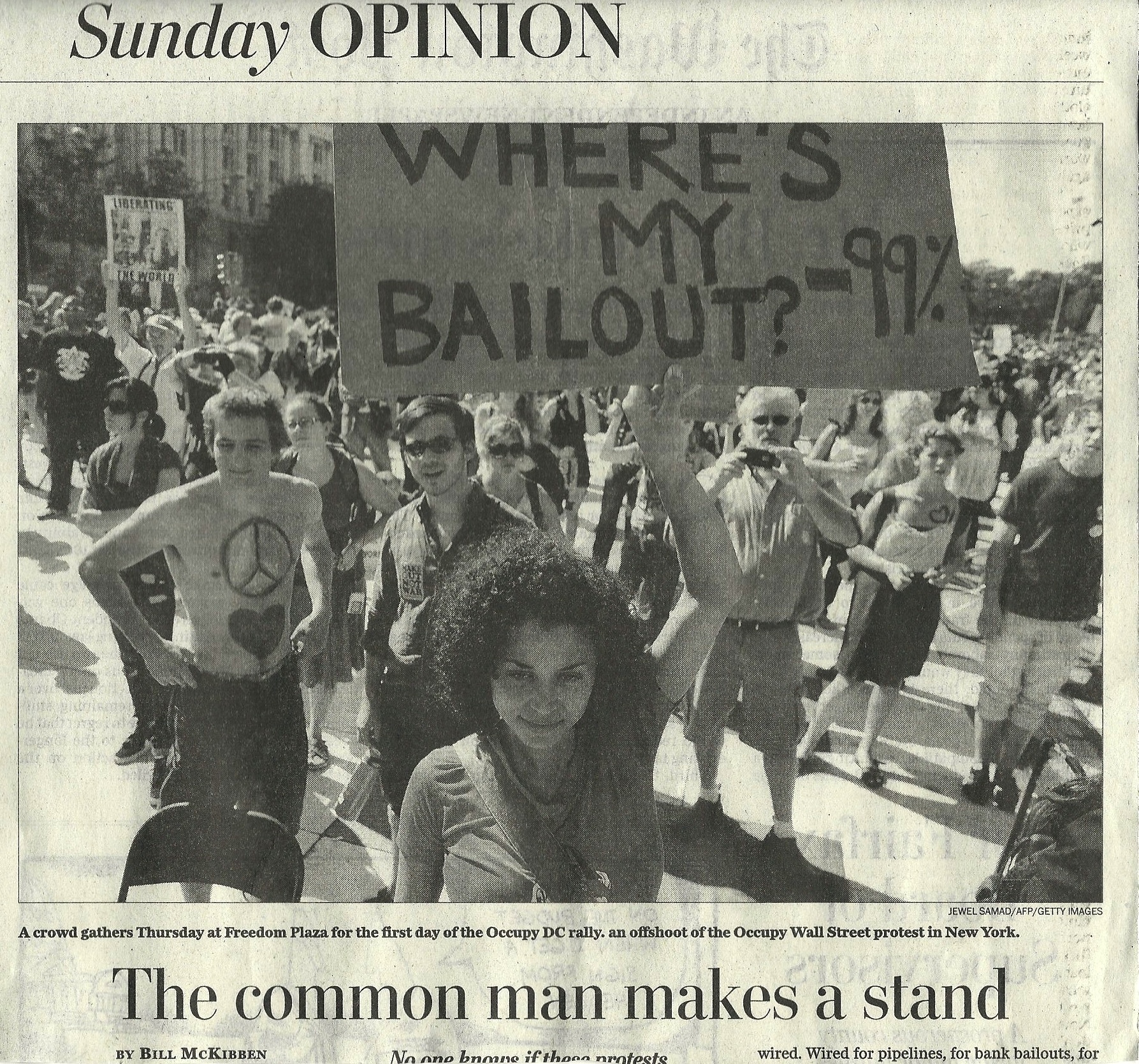
But the most idiotic media confusion in DC this week has been who was where. It wasn’t so complicated–OccupyDC at McPherson Square, Stop The Machine at Freedom Plaza. Yet in Sunday morning’s Washington Post, with OccupyDC at McPherson for over a week and Stop The Machine in place since Thursday, the caption writer for this photo still got it wrong.
The WaPo caption erroneously reads, "A crowd gathers Thursday at Freedom Plaza for the first day of the OccupyDC rally..."
And the headline–hello? It isn’t the same as the one used online, but, “The common man”? Really? Which century is this? They also apparently didn’t look at the photo which rather clearly shows the common woman.
With this kind of media, no wonder many people are confused about what is happening in the streets.
The best way to understand the movement that is taking root everywhere is to go find out for yourself. Yes, there is an Occupy near you.
Several people have said to me, oh it is just a bunch of kids. No, it is not. And it’s not just a bunch of hippie peaceniks either. It ranges from toddlers who are there with their parents (there was a little area with toys and crayons at OccupyDC yesterday) to elders with plenty of folks in between. I talked for a bit with a young man in an army uniform. It was very courageous for him to be there. He had been to Iraq once and was due to ship out again soon, but he said he wasn’t planning to re-deploy, what he had experienced on his first tour had made him realize that militarism was deeply flawed. He looked sad and wise beyond his years.
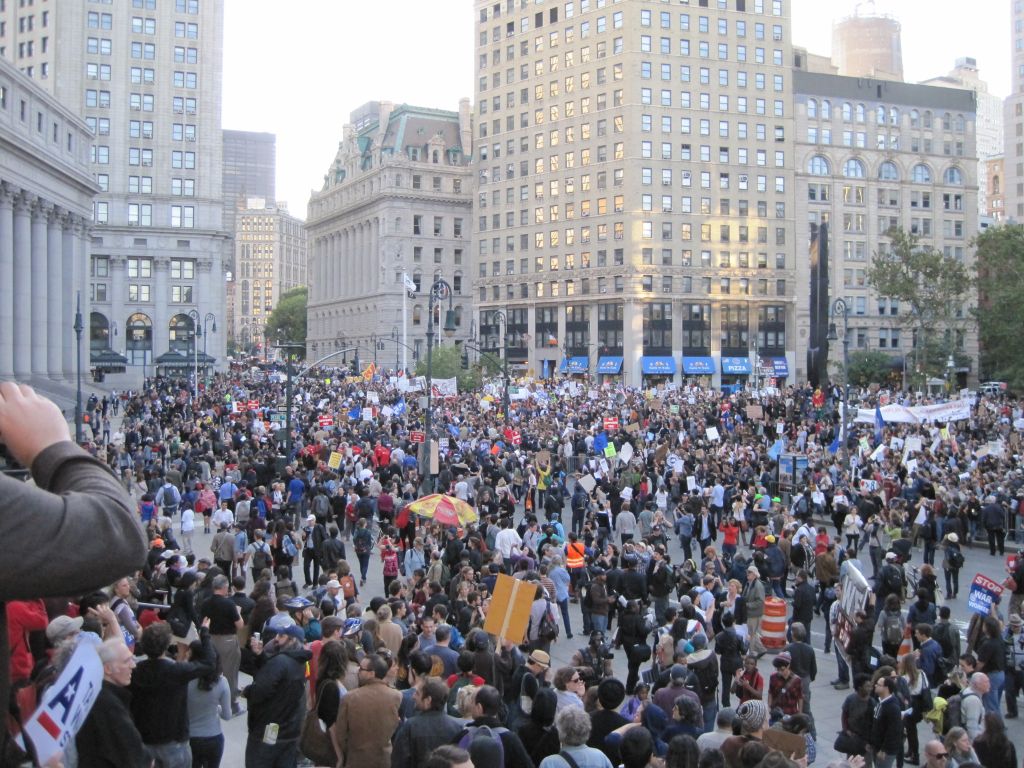
And do not underestimate the numbers, it isn’t just a hundred here and a thousand there, it is far, far larger than that.
A crowd shot at Occupy Wall Street--that is A LOT of people
This isn’t about one issue, it is about the American people connecting all the issues and finally saying enough. There are those who have criticized what is going on for not having a clear statement of purpose or intent. What they miss is that people everywhere have decided to take back the commons, and that is intention enough.
There is more to say, much more, the time I have spent on the street this last week has been transformative. I have re-connected with old friends, made new ones and for the first time in a long time felt genuine hope. Don’t be afraid, come out and join us.
July 6, 2011 / Lucinda / Comments Off on Ode To The Rotary Phone (Written While On Hold Due To The Usual Unusually High Call Volume)
Relocating after living in the same place for 24 years is, to say the least, a major upheaval. The packing and unpacking of a life is in parts exciting, sad, exhausting and surprising (“I was wondering where those snow boots had gone to”, uttered just this evening when I found them in a box labeled “wicker”). I expected all this and I knew that the thing that was going to make me the most crazy was dealing with connecting new utilities and getting new phone and cable service.
That part of the process has surpassed my worst expectations. By my count, I have spent about 20 hours waiting and holding. Plenty of time to meditate on the the meaning of customer service and to write a blog about it (sweet revenge she said cradling the phone to her ear while she’s on hold).
As I sit here listening to muzak that should be considered a public nuisance, it occurs to me that the invention of the touchtone phone has had a significantly negative impact on our lives. The beauty of the dial phone was that there was no way for a recording to tell you to dial one for more options, someone actually had to talk to you and ask you what you wanted. And what with the cost of overseas calls back then, there was no chance of that person being at a call center in Bangalore. No one asked for the last four digits of your “social” or threw trick questions at you like where you banked 10 years ago (information that is all too available in public records but which most of us have long since all but forgotten).
While I’m still on hold, I want to give a couple of special shoutouts. First, kudos to the local sanitation department that actually had a “press one to speak to someone” option. When I pressed the one button, someone actually took the call. I almost hung up and did it again just to be sure I wasn’t hallucinating.
The worst service award goes to Verizon which gave me an 8 hour window for a service call and then showed up an hour after that. All this to connect an old fashioned landline (not one of these new fangled digital phones that won’t survive an extended power outage yet is somehow supposed to be a huge improvement). And at that, they screwed up and I had a phone that I could get calls on (I know this because it had not dawned on me to put the number on the Do Not Call list in advance and I got inundated with marketing calls within an hour of service being established. But if I wanted to make a call? Nope. They had to come back the following day for that.
Second prize goes to Comcast. After scheduling internet and cable installation, I realized I’d have to change the appointment day. The phone number on the confirm letter didn’t work (I couldn’t make that up if I tried) so I decided to do it via the Live Chat option online. Here is how the conversation should have gone:
Comcast: How can we help you Ms. Marshall? Me: I’d like to change my service appointment. Comcast: Sure when would be a more convenient time? Me: Wednesday at 11. Comcast: Sure, no problem, see you then.
Suffice to say, my 45 minute conversation with Tricee didn’t quite go like that. On the plus side, because it was online, I have the whole fricking transcript in all its absurdity which can be read below, but here is one of Tricee’s best utterances to peak your interest:
Tricee: I understand that you want to reschedule your service installation, Lucinda. No worries. As your Comcast service representative, I want you to know that issue resolution and your satisfaction are my top priorities for today. By the end or this chat we will be able to address your concern properly. Together, we can work this out, Lucinda.
You have to love her Rosie the Riveter-esque approach. Like Verizon, Comcast also missed their service window. For this, the guy on the phone when I called to find out where the heck they were told me I would get free HBO for 3 months, but when the service tech hooked it up, no HBO. I called again and was told there was no record of my being promised the HBO and that they never offered that. But the next week I got a bill and apparently it was part of the package I got in the first place and now I’m getting HBO. Some deal offering me what I’d already paid for and then denying that they offered it. They also told me they’d give me a router. Yeah. No. Called about that and was told I’d have to pay for shipping and it would take a few weeks. File that in the Another Hour On Hold Department.
Finally, there is a special place in hell for cell phone companies with their inexcusable return policies and 2-year contracts and the latest obscenity, tiered data plans (the best part of this is that phones can use up your data allowance without you knowing it, and you have no way to control it). Before embarking on this move, I went to Verizon Wireless and replaced my older and sometimes erratic Blackberry with a new one, which of course got me stuck in another 2-year contract. All was well until 20 days later (6 days after the window to return it ran out) when it quit functioning and the battery heated up. So I headed for the nearest Verizon store where I had to wait half an hour before anyone could help me (did I mention there wasn’t enough seating for all the people who were waiting?).
First they told me I could either upgrade or wait for a replacement via mail. At that point I asked for a manager and told him I wasn’t upgrading a 20 day old phone and leaving me without a working cell phone until a new one arrived was not okay. I think by that point I was looking a bit wild eyed, possibly even foaming at the mouth and the manager took the point and swapped it out. Which is what should have happened at least 20 minutes sooner. All told another hour and a half at Verizon.
I spent another hour getting the settings on Son of Blackberry tweaked and then last night apparently its bad genetic makeup kicked in and it started acting like its predecessor. This morning I spent yet another hour and a half at Verizon and am now learning to use an IPhone.
To their credit, the store personnel did the right thing, the manager told me he would waive the re-stocking fee (for a phone that mal-functioned after a week? Really?) . But it shouldn’t be that complicated, and having to stand at a counter with numerous other customers where everyone is trying to talk louder than the next guy to be heard for a long period of time isn’t customer service, it is deliberately designed to wear customers down which is the same rationale behind press 27 numbers to be put on hold to speak to someone who speaks an indecipherable version of English who tells you that a solution to whatever it is you called about if you can even remember why you called by that time will cost you an arm and a leg or there is no solution and you are shit out of luck but is there anything else they can help you with and would you like to hear about today’s special and take a short survey.
Wait, what happened to the muzak? They disconnected me?? I miss my rotary phone.
———-
Transcript of my Comcast Live Chat (redacting and emphasis mine):
user Lucinda has entered room
Lucinda: I want to change my installation appointment but your phone number doesn’t work. Please call me Wednesday to see if we can schedule an appt. for this Friday instead of next Monday.
analyst Tricee has entered room
Tricee: Hello Lucinda, Thank you for contacting Comcast Live Chat Support. My name is Tricee. Please give me one moment to review your information. Tricee: I understand how frustrating this might be, I apologize for the inconvenience. Rest assured I will do everything within my means to address your concern today, Lucinda. Tricee: How are you doing today, Lucinda? Lucinda: I just want to change my appointment time Tricee: I understand. Tricee: May I know for what service will be installed and on what date was it scheduled. Lucinda: internet and cable on June 20 Tricee: Thank you. Tricee: I understand that you want to reschedule your service installation, Lucinda. No worries. As your Comcast service representative, I want you to know that issue resolution and your satisfaction are my top priorities for today. By the end or this chat we will be able to address your concern properly. Together, we can work this out, Lucinda. Lucinda: Also can you give me a real phone number, 800-266-2278 keeps saying the call can’t be connected. Tricee: Our Comcast hotline is 1-800 XFINITY – 1-800-934-6489, Lucinda. Lucinda: Can you reschedule it for June 17? Lucinda: Thank you for the phone number. Tricee: We will check for the schedule, Lucinda. Tricee: Thank you for providing your account information. Would you please verify the information I received is correct? First name Lucinda Last name Marshall Phone Number XXXXXXXXXX (for the obvious reasons redacted by me) Tricee: Your’e welcome. Lucinda: correct Tricee: Thank you. Tricee: For security purposes, may I have the account holders name and the account number. Lucinda: Lucinda Marshall, acct. ends in XXXX, I have no idea what the rest of it is, it isn’t in the email they sent me, this is for new service. Tricee: Thank you. It’s alright. Tricee: May I have your complete service address. Lucinda: (Removed to protect my privacy) Tricee: Thank you. Tricee: I sincerely appreciate your effort for providing me with all the necessary information that I need, Lucinda. Please allow me 1-2 minutes to verify your account. Tricee: Lucinda , while waiting, I’d also like to tell you that music lovers and enthusiasts can now enjoy original shows, interviews, music videos organized by genre, 16 video and forty six audio channels, create customized playlists and music channels. To access all these simply log-on to www.comcast.net/music. Lucinda: I am not interested in any sales pitches, just changing my appt. which should not be this complicated. Lucinda: Or take this long. Tricee: I understand, Lucinda. Tricee: Thank you for patiently waiting, Lucinda. I have successfully pulled-up your account. Tricee: Let me check if June 17, 2011 is available. Lucinda: Thank you. Tricee: Your’e welcome. Lucinda: So is it available? (A ridiculously long pause happened here) Lucinda: Hello? Tricee: Sorry for the delay, Lucinda. Tricee: I am still waiting for the dates to load. (It took everything I had not to ask if he, she or it was using Comcast internet) Tricee: Great! Tricee: All is set, Lucinda. Lucinda: Can they come in the morning? Tricee: Your installation date is now on June 17, 2011. Tricee: Yes, that’s 8:00 – 11:00 AM. Lucinda: Excellent, thank you very much, will you send me a confirmation email please. Tricee: Before we finish up, Lucinda, I want to remind you that we have rescheduled your installation date. I have left a note on your account for the next representative that will assist you. Tricee: You are most welcome, Lucinda. Tricee: By the way, Lucinda, can you do me a little favor? At the end of this chat there will be a short survey. I would appreciate it if you would spare a moment to complete it so we can continue to improve the service we provide you. Lucinda: Please send me a confirmation email. Tricee: Will do, Lucinda. Tricee:I’m glad I was able to help you. Do you have any other questions or concerns I can help you with today, Lucinda? I will be more than happy to assist you further. Lucinda: Sorry, this has taken too long, I have to go to bed. Tricee: It’s alright, Lucinda. Lucinda: Goodnight. Tricee: Lucincda , (sic) it is with gratitude to have you as my customer on this chat and I appreciate the opportunity you’ve given us today to resolve your issue. Thank you for choosing Comcast as your service provider and have a great day! Comcast appreciates your business and values you as a customer. Our goal is to provide you with excellent service. If you need further assistance, you can chat with one of our Customer Support Specialists 24 hour a day, 7 days a week at http://www.comcastsupport.com/chat. Tricee: Please click the `Exit chat` button to properly close the chat and take the survey. Have a great day! Take care, Lucinda!
March 21, 2011 / Lucinda / Comments Off on And That Was The Day That Was–Monday Edition
Epic Days are becoming far too common place, and not in a good way. From today’s headlines–A no fly zone in Libya that seems to be taking out about as many civilians as targets in order to support rebels of uncertain political aspirations (perhaps on the assumption that they could hardly be crazier than Gaddafi and dammit, we need that oil). Memo to the good people of Sudan, Ivory Coast and other places where innocent civilians are under siege–sorry, your lives aren’t worth jack unless you’ve got something we want.
And while everyone is totally distracted, Israel starts in on Gaza again. Meanwhile existing home sales skidded, well actually nose-dived would be a better adjective, the NRC says no changes needed in the U.S. nuclear program while the Japanese figure out how to deal with radioactive lettuce and milk and still smoking reactors not to mention the significant percentage of their country that just got trashed by Mother Nature.
The World Bank says no worries though, the Japanese disaster won’t have a long term effect on the global economy. Oh and trophy pictures have surfaced of U.S. soldiers gloating over dead civilians in Afghanistan, which couldn’t possibly be true because Abu Ghraib was just a few bad apples.
I probably missed a few things, but truly that is enough, and that was just today. Dear ones, we cannot continue like this. Kurt Vonnegut warned us about becoming what we pretend to be. But we seem hellbent in doing just that and it is a very sorry sight.
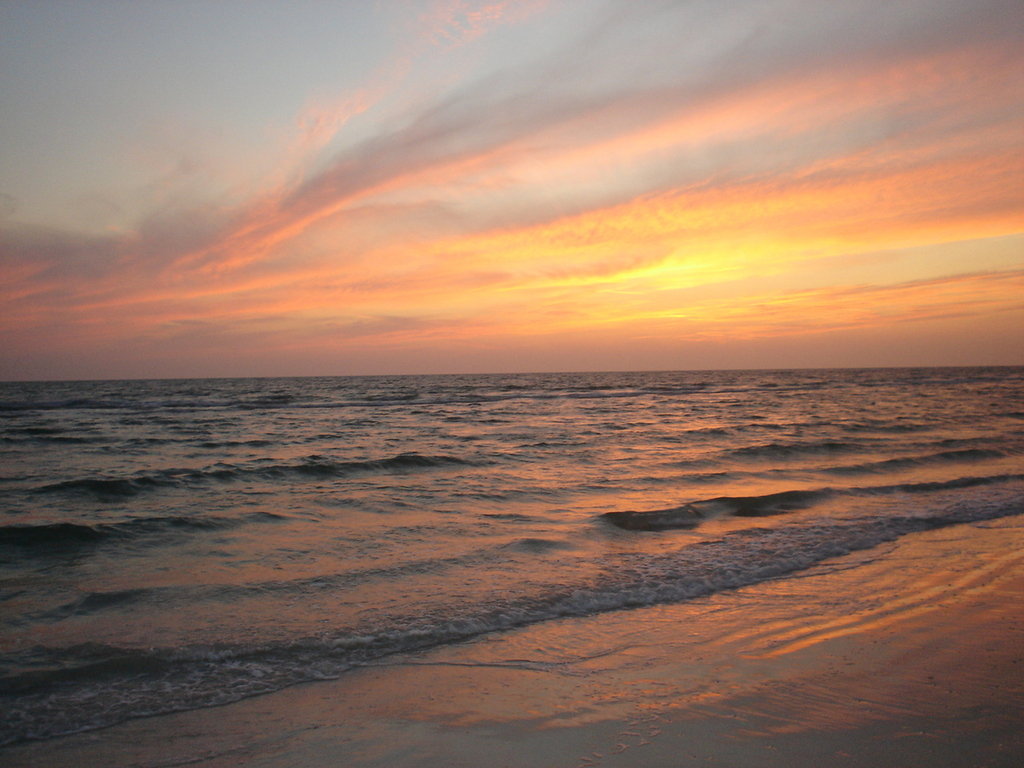
A few years ago we spent a long weekend at a lovely hotel on the pristine St. Petersburg, FL shore. We walked along the beach, collected shells, ate seafood. Yesterday I got an email from them telling me they weren’t Pensacola and to come on down, the water’s fine. They even have their own no-spill-here -cam.
“Public officials have failed to sound an alarm about the public health threat because three federal agencies – DHHS, EPA, and OSHA – cannot find any unsafe levels of oil in air or water. Perhaps the federal air and water standards are not stringent enough to protect the public from oil pollution. Our federal laws are outdated and do not protect us from the toxic threat from oil – now widely recognized in the scientific and medical community.
BP is still in the dark ages on oil toxicity. BP officials stress that, by the time oil gets to shore, it is “weathered”
After wading in 'safe' water...
and missing the highly volatile compounds like the carcinogenic benzene, among others. BP fails to mention the threat from dispersed oil, ultrafine particles (PAHs), and chemical dispersants, which include industrial solvents and proprietary compounds, many hazardous to humans.
If oil was so nontoxic, then why are the spill response workers giving hazardous waste training? Our federal government should stop pretending that everything is okay. What isn’t safe for workers isn’t safe for the general public either.”
It bears remembering as well that the monitoring that is being done of air and water quality is not up to elementary school science standards in some regards. NRDC’s Gina Solomon points to sample results that, “don’t say where they were taken, and who was in the area.”
Questions have also been raised about testing labs with ties to BP and the veracity of assertions that dispersants are not in the air and increased arsenic levels. And then there is the matter of report after report of reporters being denied access to the effected areas. Bottom line–between deliberate misinformation, denial of access to information and an approach to scientific fact checking that is less sophisticated than a kid’s chemistry set, assurances of safety along the Gulf are suspect at best.
But that is not even the most dangerous part of the story. As I pointed out a few weeks ago, the oil disaster, first framed by BP, the government and media as a regrettable spill, quickly escalated into a war that needed to be fought. As Anne McClintock writes,
“Billy Nungesser, indefatigable President of the Plaquemines Parish, implores anyone who will listen: “We will fight this war….We will persevere to win this war.” For Ragin Cajun, Democratic strategist, James Carville: “This is literally a war… this is an invasion…We need to hear someone say ‘We’ll fight them on the beaches.’” Retired Gen. Russell Honore, who oversaw the Katrina debacle, insists: “We need to act like this is World War 111. Treat this like it’s an invasion…equal to what we decided about terrorists. We’ve got to find the oil and kill it.”…
…Visit the BP site (one of the more surreal Alice-Through-the-Looking-Glass internet experiences) and you will see the word “kill”–BP’s favored, faux-techno buzzword–appearing with ritualistic incantation. Kill the well, kill the leak, kill the oil, which morphs into “kill mud” (the mud that will kill the leak) and “kill lines” (the lines that follow the pipes to kill the leak)..
…So why are people calling the calamity a war and why does it matter that they do?
Calling the oil the ‘enemy’ helps us not to question who was culpable in the first place. Calling the response ‘a battle front’ helps us not ask who, other than the military, should be in charge. Calling the spill an ‘invasion’ helps us not to see that our global culture of militarization is what got us into the mess in the first place. Calling the spill a ‘war’ only fuels the pervasive militarization that produced the crisis in the first place. And calling the oil the enemy helps us not admit how much we, the consumers, having awakened the oil from its ancient slumber to fuel our gas-greedy lives, are the most complicit of all…
…All this war talk would be understandable, defensible even, were it not for a fatally circular, feedback loop. BP would not be in the Gulf drilling deeper than it knows how to drill were it not for its uniquely profitable relation with the US military war machine. The United States Department of Defense buys more oil than any other entity on the planet. The protection of overseas oil is now so unquestioned that even Defense Secretary Gates warned against the “creeping militarization” of U.S. foreign policy. And to fuel this militarization, the Pentagon uses 75% of the oil bought by the DOD for its jets, bombers, drones, tanks, and Humvees. And in order to keep buying this oil, the military has to keep protecting our regional oil interests, two thirds of which are now in conflict prone zones. US military bases in Iraq and Afghanistan use a staggering ninety million gallons a month. And to garrison this vast, global gas-station, the DOD keeps expanding, which means buying more oil.
From whom? In 2009, BP was the Pentagon’s largest contractor at $2.2 billion…
…Keeping this in mind, we would do well to remember that militarization is the number one cause of environmental destruction in the world, and that military production facilities, which are exempt from environmental restrictions, are the most ecologically devastated places on earth. We drill, we spill; nature pays the bill.”
GritTV’s Laura Flanders asks some important questions about the connection between the economy, which according to experts such as Paul Krugman and Robert Reich is in serious trouble, and the military:
“The US is currently shedding hundreds of thousands of jobs each month. It’s not just in the Ozarks that the recruiters are the only ones with jobs around. The economy shed 125,000 jobs in June. That’s about the number of troops we have left in Iraq…
…We’ve long heard about fighting people over there so we don’t have to do it here. Is the colder truth becoming that we’re sending people over there because we sure can’t employ ’em over here? And we’re scared to death of what unrest might come with a massive return of men and women who’ve served and endured — and who expect something better for their families than starvation wages, and no social services when they get back?”
I think there is a lot of truth to that as well as to the fact that a bad economy makes for fruitful military recruitment when kids can’t get jobs or afford college, why not join the military like that cool recruiter who hangs out at lunch in the cafeteria in that bad-ass uniform is pushing you to do. As McClintock points out, the military is busy defending the oil on which its existence depends. And for that it needs an endless supply of human cannon fodder.
And so we fight pointless wars without end rather than actually defending our citizens or literally, our shores. We allow the real enemy to tell us how to ‘clean’ up the resultant disaster and to control the information flow even while the oil flows unabated, because we are addicted to their product and our Congress has been bought off.
As for the beaches of St. Pete–are they safe? Perhaps. I hope so, but we simply cannot have enough confidence in what passes as data to say so, even if the damage is not visible. What is unquestionably dangerous however is the wholesale usurpation of government oversight by a lawless private corporation and the denial of freedom of the press in covering this story. As damaging as this disaster has already been to the ocean, shoreline and inhabitants of both, it will continue to be more so unless we insist on proper precautions, good science and full transparency. Above all, it is time to take a long overdue, very hard look at just what our military is supposedly defending and why and how, in the end, real security is defined.
A few years ago, you couldn’t even get a For Sale sign up before a house that was for sale sold in my neighborhood. Good schools, quiet, great access to downtown, yada yada, suburban paradise. Now you can’t give them away. It’s not really a surprise, as I pointed out in September, 2009:
“As for the foreclosure crisis–that nasty little house of cards seems to have eased. Or not. Seems there are some mortgages called Option ARMs about 70% of which will reset before 2011, some by as much as 63% leaving a whole lot more people with not much of an option but to go into foreclosure, so that one isn’t over yet either.”
Pretty obviously the rose-colored punditry that we were hearing at that point has indeed turned out to be tripe, something that gives me no pleasure to be right about since I would dearly love to sell my now empty nest and move elsewhere. As this rather astute piece points out it really is that bad, and maybe worse:
“Is the housing market already double dipping? That certainly appears to be the case – and exactly on cue as the government steps aside. While the mortgage applications are no guarantee of a renewed trend the warning flags are popping up all over the place. In addition to the negative seasonal trends ahead of us, we are also seeing lumber prices off 33% in the last month, continuing high historical inventories, a slew of mortgage resets in the coming years, and the biggie – the end of government intervention.”
Back in September there was an asinine discussion going on about whether the recession would double dip and if so what form it would take–everyone was using letter shape analogies. My take on that was never mind letters, think roller-coaster:
“the most terrifying ride in the park–you go up a little and then down, your heart lands in your stomach and you’re afraid you’re going to upchuck all over your date but then you realize that you survived and it isn’t so bad and hey you’re going up again. And then you get to the top of the next rise and see the very long and steep decline that lies ahead…
…Whether or not the recession is ending is irrelevant and not even the correct question. At best, we are in a bit of economic remission, but do not be deluded, the ride has only just begun, and the big fall is still ahead.”
Anyone taking bets on whether we’re at that last crest before the big fall now?
June 5, 2010 / Lucinda / Comments Off on Wanna Buy Some Oily Swampland In Florida?
As things get more and more surreal every moment on this planet, it becomes difficult to write in a way that
A last romp at the beach?
doesn’t send you the reader or me the writer into tears or over a cliff. While the oil continues to gush, there have been some truly bat-shit scary ideas of how to stop it, including the Dr. Strangelove nuke it solution. Nuking a hole in a gushing hole, radiating the gulf and who knows what else when the wind blows is helpful how?
One thing to be said for that idea, it makes the idea of putting the military, you know the one that is winning the wars in Afghanistan and Iraq, in to deal with it almost sound sane. I said almost. But not to worry,
“U.S. Defense Secretary Robert Gates is rejecting a more forceful role for the military in plugging the Gulf of Mexico oil leak.Gates says the deep-water disaster is beyond the military’s expertise.”
Osama Bin Laden is rolling on the floor laughing in his cave. We spend how much every year to protect ourselves against all manner of ‘terrorism’ and when we actually have a real something to be afraid about, the military’s response is ‘We got nothing’? Oh and in answer to how much we spend to not be able to defend ourselves against real threats, here is the growing count and amount,
“The US spent $661 billion on its military in 2009, a 75.8 percent increase from 2000. While current US military spending is still a carryover from the years of George W. Bush, President Barack Obama shows no signs of cutting spending. The Nobel Peace Prize winner excluded security-related expenditure from a planned three-year squeeze in discretionary expenditure. At a recent hearing before Congress, Secretary of Defense Robert Gates talked about efforts to trim the fat but the proposed Defense Department baseline budget for fiscal 2011 is $708 billion.”
But don’t look to divert any of those funds to cleaning up wetlands or providing employment assistance for those along the Gulf who now joint the ranks of the already beleaguered unemployed. After all, a strong defense is important.
And then there is the Goldman Sachs oh so timely sale of BP shares? No need to be suspicious of that with Tim Geithner at the helm.
And the recession remember the recession? Is it back? Might could be, hardly a surprise, ‘splains the mirage like quality of our supposed recovery.
And in the miscellaneous oh there’s a surprise category:
1. Meanwhile, we spent how much money fighting the less than epic swine flu pandemic to the benefit of big Pharma and why? Remember Rumsfeld’s connection with Tamiflu? Nuf said.
2. And radioactive fish? Has nothing to do with proximity to nuclear plants.
Meanwhile, Arizona is doing its damnedest to whitewash itself, Israel went into its bat shit bully mode and the DADT debate is promising to last longer than the healthcare debate. I won’t even bother with links for those, you know, and I can’t bear to even spend the time to remind you. Stay tuned, the bad news is there will be more bad news and worse yet, more bad lies. And you’ll never guess who is going to get stuck paying the tab.
We Americans are not very good at telling or hearing the truth, although we’d like to think that we are. We tell our schoolchildren that George Washington could not tell a lie about chopping down the cherry tree, even though, ironies of ironies, the story likely isn’t true. We fall all over ourselves giving the microphone to people whose whole understanding of the world is a lie (Rand Paul, Sarah Palin) because while we might not be very good at discerning or disseminating facts, we do so love our fiction.
“Next year’s budget allocates $159,000,000,000 to “contingency operations,” to perpetuate the occupations of Afghanistan and Iraq. That’s enough money to eliminate federal income taxes for the first $35,000 of every American’s income each year, and beyond that, leave over $15 billion that would cut the deficit.”
But the marshes are being destroyed, the oceans poisoned–there is no going back from this and as yet no way to stop it. This isn’t Exxon-Valdez, it is far, far worse and the damage beyond anything this country has ever seen and one which cannot be fixed. The Gulf coast as we know it is gone. The fishing, the tourism. There will be health consequences. There won’t be fish. Or perhaps coral reefs. Or perhaps us. And that is the truth of it.
“No one knows how much of BP’s runaway oil will contaminate the gulf coast’s marshes and lakes and bayous and canals, destroying wildlife and fauna — and ruining the hopes and dreams of countless human families. What is known is that whatever oil gets in will be next to impossible to get out. It gets into the soil and the water and the plant life and can’t be scraped off the way you might be able to scrape the oil off of a beach.
It permeates and undermines the ecosystem in much the same way that big corporations have permeated and undermined our political system, with similarly devastating results.”
And just how devastating? As bad as the consequences of what we have seen so far will be, it may get far, far worse:
“The oil field the Deepwater Horizon had tapped is said to be the second largest deposit in the world. Viewzone.com reports, “The site covers an estimated 25,000 square miles, extending from the inlands of Alabama, Florida, Louisiana and Texas. “
The oil deposit is so large, it could produce 500,000 barrels of a day for more than a decade.
Part of the reason the well exploded is because the site also contains large deposits of natural gas…
…The New York Times has reported that scientists suspect the leak is thousands of times larger than what BP has been reporting. Some estimates are as high as one million gallons a day.
Rock particles, gas and oil escaping under pressure are pushing against the capstone on the sea floor that surrounds the actual well. If it collapses, the canyon of oil will escape with a vengeance.
Neither BP nor anyone else wants to say what will happen it the wellhead gives way or the sea floor around it caves in.”
———-
———-
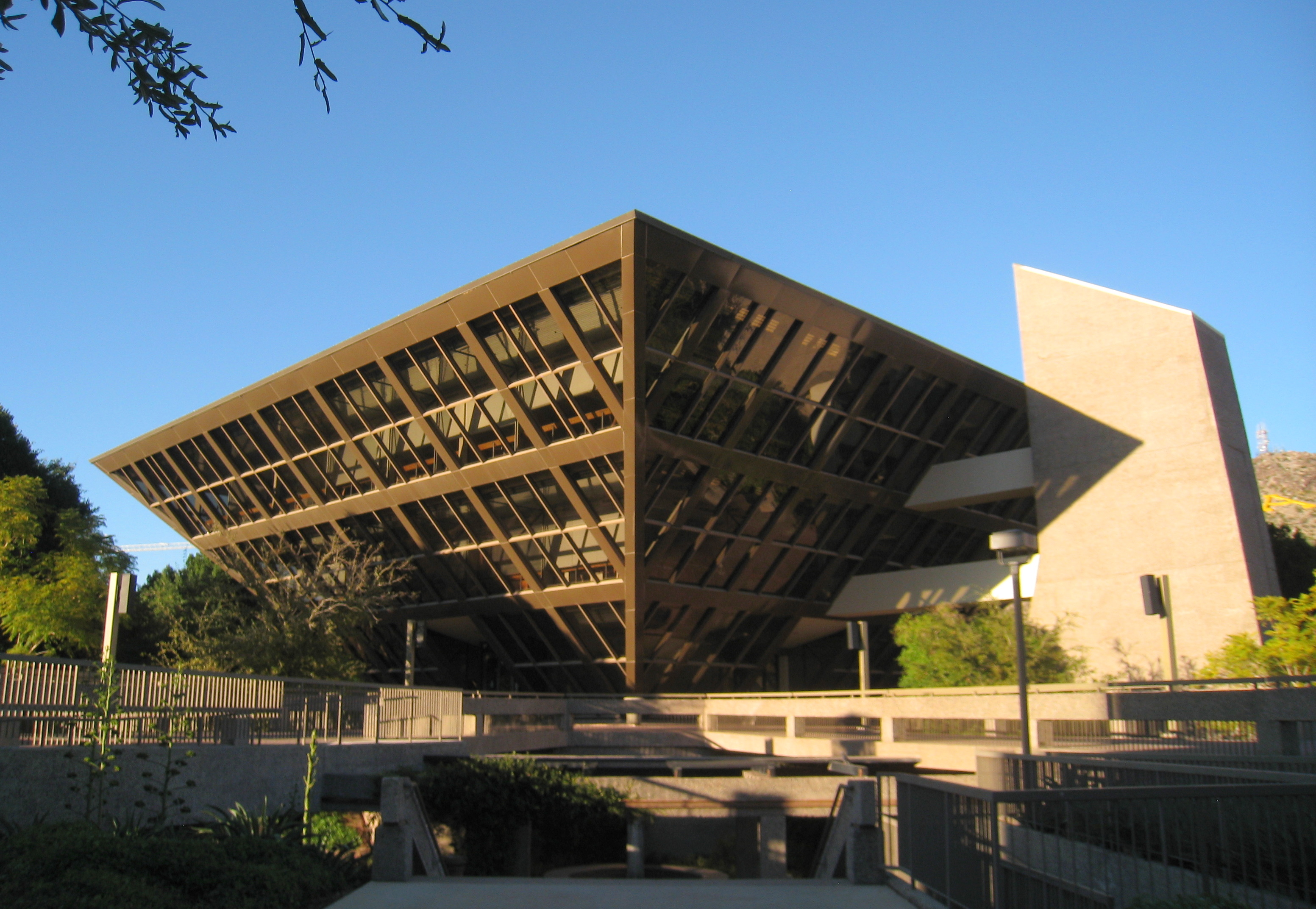
Meanwhile, to hear government officials and Wall Street tell it, the economy is recovering, and perhaps in the language of economics it is. But in truth the ‘recovery’ looks something like an upside down Ponzi scheme, a bit like the Tempe, AZ City Hall.
All the wealth is at the top but there is little to support it down below–and unlike the architecturally brilliant building, the upside down economic pyramid must eventually fall down. We have almost pathological blinders when it comes to seeing the obvious perils to our continued existence–climate change and global warming, peak oil, water and food shortages, melting glaciers, species extinction, deforestration, floods, droughts, oceans under siege. But still we gulp the koolaid and believe that growth is good and things will be better soon. And we are just as blind when it comes to understanding that commodifying the sanctity of corporate well-being over human welfare is ultimately our downfall, not the path to prosperity that it claims to be.
I don’t watch much television, but I guess I should because it seems there is a Tru Tv which claims to be, “television’s destination for real-life stories told from an exciting and dramatic first-person perspective. “Not Reality. Actuality”. The truth will not be televised, but television is truth. As for the American dream, it is the reality show to end all reality shows. And in the finale, the truth will out, but unlike “Lost” or American Idol”, there won’t be re-runs and don’t hold your breath for a spin-off or a sequel.
———-
Note regarding dispersants: Via the Times Online this is why these are so very dangerous. I would add that we should be extremely worried about the impact on reproductive health on animals and humans as well:
“Dispersants can contain particular evils. Corexit 9527 — used extensively by BP despite it being toxic enough to be banned in British waters — contains 2-butoxyethanol, a compound that ruptures red blood cells in whatever eats it. Its replacement, COREXIT 9500, contains petroleum solvents and other components that can damage membranes, and cause chemical pneumonia if aspirated into the lungs following ingestion.
But what worries Dr (Susan) Shaw most is the long-term potential for toxic chemicals to build up in the food chain. “There are hundreds of organic compounds in oil, including toxic solvents and PAHs (polycyclic aromatic hydrocarbons), that can cause cancer in animals and people. In this respect light, sweet crude is more toxic than the heavy stuff. It’s not only the acute effects, the loss of whole niches in the food web, it’s also the problems we will see with future generations, especially in top predators.””
One of the problems with the gulf oil disaster is it isn’t a 30 second and we’re done sort of a story. Nor is it a simple story–the amount of leaking oil, the extent of the damage, who is to blame, the path it will follow and how well the ‘cleanup’ will work are all aspects of the story that will be unknown for quite some time.
It’s a hard story for the media to cover and a hard one for the public to fully grasp. In an effort to try to understand what we know at this point, I started making a list of links to information about various parts of this story. And because I’m a really nice person who likes to share, here is what I found:
Alaska Senator Lisa Murkowski still thinks offshore drilling is a good idea, which is understandable since she raked in $400,000 in contributions from the oil and gas industry during an 8 year period.
Think this kind of eco-catastrophe like this can’t happen in your area because there isn’t off-shore drilling? Think again. And lets be mindful that we aren’t the only country experiencing problems.
Meanwhile, dead turtles like this are starting to wash up on our shores:
Unquestionably, the damage to the gulf eco-system will be horrific and there is substantive worry about the dispersant agents that are being used. There is also the horrific possibility that cleanup efforts could be thwarted and the damage spread during hurricane season.
And how did it happen–this excellent graphic from NOAA explains:
And as if that weren’t all depressing and infuriating enough, the story that should be screaming at the top of page one but is almost completely awol in the media is this:
Finally, here is a series of videos running around the web this morning showing just how easy it is to boycott BP–you drive away and go to another gas station to tank up. While boycotting BP is a worthy idea, doing it in your car might possibly be missing the point. Here is another idea that makes the point in a slightly more principled way. Call some friends, get some drums to bang on and make some signs and go stand in front of a well-traveled gas station and make some noise. Count me in.
Lucinda Marshall is the author of the full-length poetry collection, Inheritance Of Aging Self (Finishing Line Press,2021) and is available for purchase from Finishing Line Press, Barnes and Noble, and Amazon. She is also a quilt, mixed media, and graphic design artist. For more information, please email LucindaMarshall @ lucindamarshall.com.
 In the pre-hurricane calm before Sandy hits, I am sitting by a window (where I probably don’t want to sit tomorrow), watching the skies darken and thinking of a young man that I’ve known since he was in diapers. After high school, he joined the army and last week, he left to serve in a war zone. All we can do now is pray that he comes back alive, hopefully without his body or mind broken.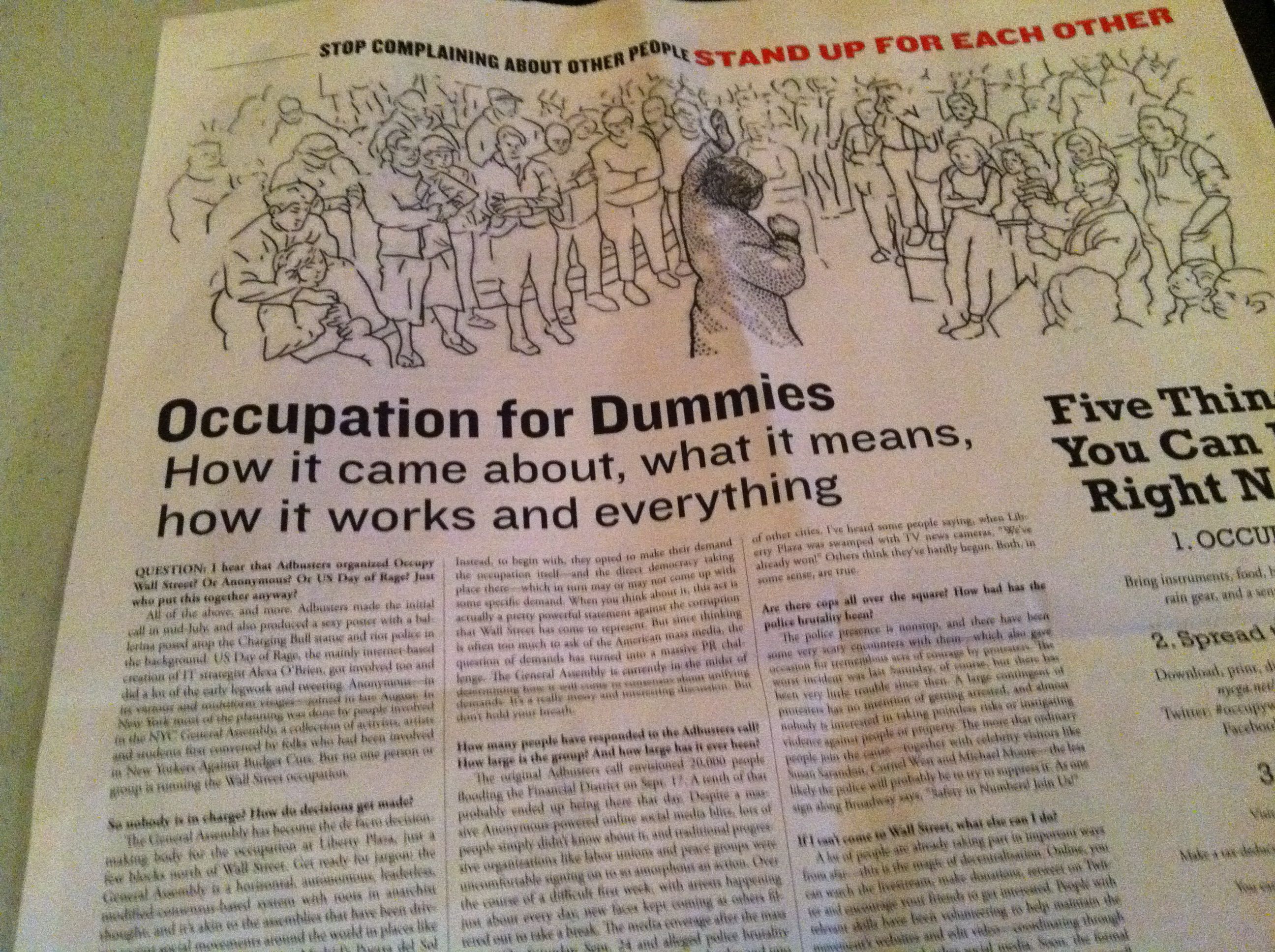
 the least, a major upheaval. The packing and unpacking of a life is in parts exciting, sad, exhausting and surprising (“I was wondering where those snow boots had gone to”, uttered just this evening when I found them in a box labeled “wicker”). I expected all this and I knew that the thing that was going to make me the most crazy was dealing with connecting new utilities and getting new phone and cable service.
 Epic Days are becoming far too common place, and not in a good way. From today’s headlines–A no fly zone in Libya that seems to be taking out about as many civilians as targets in order to support rebels of uncertain political aspirations (perhaps on the assumption that they could hardly be crazier than Gaddafi and dammit, we need that oil). Memo to the good people of Sudan, Ivory Coast and other places where innocent civilians are under siege–sorry, your lives aren’t worth jack unless you’ve got something we want.