Archive for Global Warming

Finding Strength In The Extraordinary Ordinary

For more than ten years now, I have devoted the overwhelming majority of my work as a writer and activist to shining a light on the many heinous guises of misogyny, especially on the impact violence has on women’s lives, and also on efforts to stop that violence and to empower women. Now and again I have also tackled other topics, including environmental issues such as global warming and climate change because as we confront environmental disaster after environmental disaster at a rapidly snowballing speed, the need to address these issues as an integral part of my work feels urgently compelling, yet words more often than not painfully fail me.

What precisely can one say about ocean acidification, leaking methane from the thawing Arctic, seas that are rising faster than expected, the loss of ice in Greenland and Antarctica, (and those are just stories that have crossed my digital desk in the last week alone)?  And how precisely can one say what should be said about these overwhelming climactic disasters in a way that accurately portrays the proper measures of terror, and the tears that should be streaming down our faces as we see the result of our misguided dominion while offering  hope or perhaps vision?  On most days, I neither know or begin to feel adequate to that task.

Not being one to suffer writer’s block or despairing inertia quietly, I have floundered about trying to find inspiration and strength, a grounded path towards coherent expression.  I have buried myself in the words of Terry Tempest Williams and tackled a lengthy biography of Rachel Carson. I cheer Sandra Steingraber’s call to action about fracking and Bill McKibben’s relentless tar sands pushback and the solar-powered Thanksgiving in the aftermath of Hurricane Sandy.

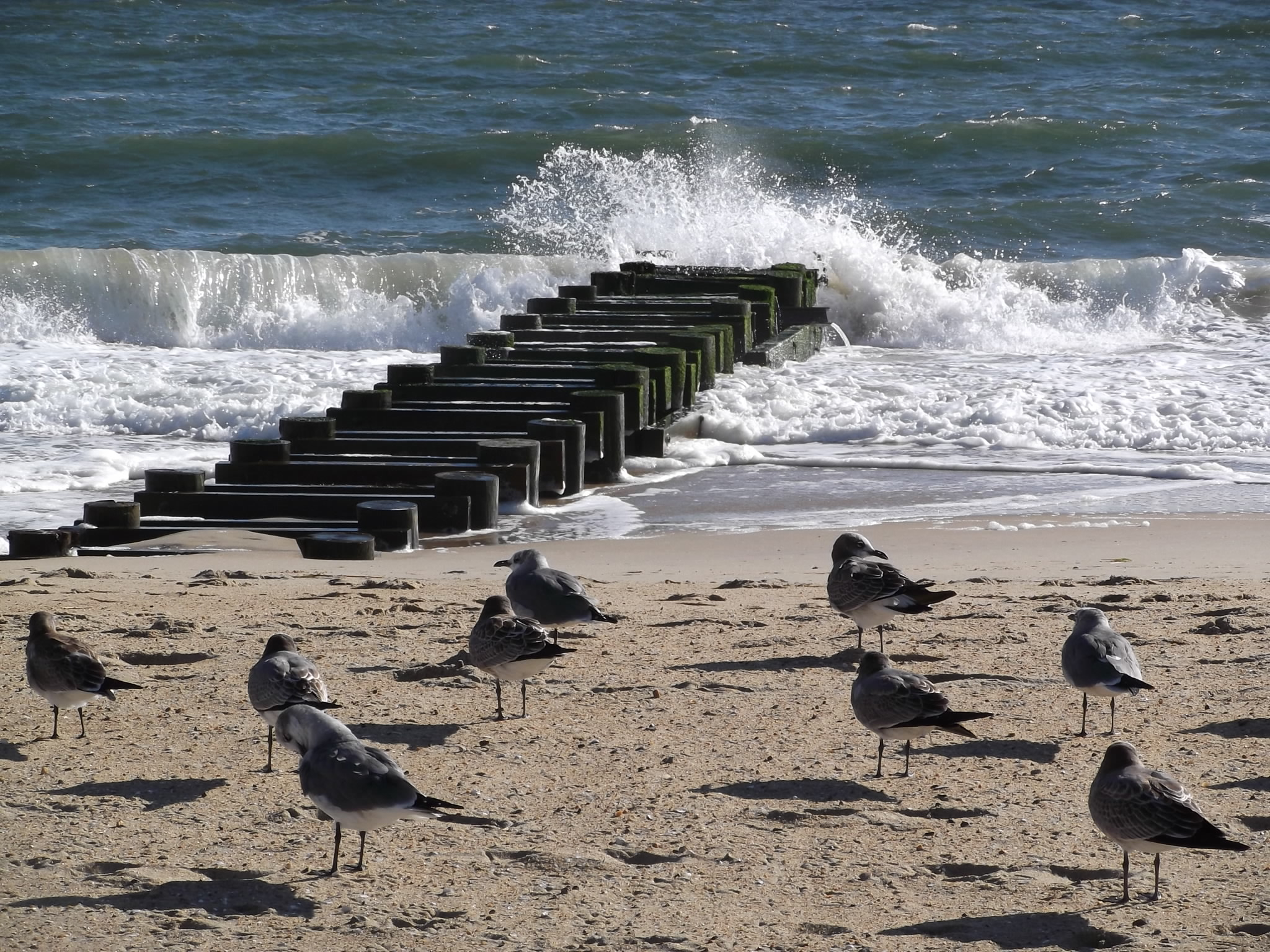
And mostly I have walked away from the computer and staggered out into the natural world, needing to take in huge gulps of (I hesitate to say fresh) air.  I have sat beside the Atlantic Ocean and watched the tides roll in and out, seagulls standing watch at the water’s edge.  I’ve walked along the Potomac, visited pueblos and mountains and craters in the Arizona desert and high country. And some days, I simply walk the streets of my suburban neighborhood.

The community in which I live is perhaps the embodiment of a sub-urban design train wreck–houses crammed in every available space, open spaces in the wrong places, dysfunctional streets where people live isolated lives.  But even in this embodiment of Malvina Reynolds’ little boxes on the hillside “all made out of ticky tacky, and they all look just the same”, I have looked up at the trees, and found wonder and love and grounded strength in these branches of heart filling beauty.

And where words come sometimes only haltingly, I have taken to letting my camera portray the extraordinary that we all too often fail to see, let alone honor in the ordinary of our days.

The words will continue, we must talk about what has been, what is and what will be.  But we must also see the tree branches above, and feel the breezes from the sea, the hot desert sun and the path below our feet.

Share

Will We Drown In Denial Or Face The Sea Change of Climate Reality

Of all the searing images in the aftermath of Hurricane Sandy, the one that I find most disturbing is this picture of the guard at the Tomb of the Unknown Soldier which remained throughout the storm at great personal danger. That we must honor our military dead even at the risk of completely unnecessary loss of life speaks volumes about our priorities in this country.

I rarely watch cable news, but I found myself obsessively switching between a local news channel, CNN and The Weather Channel for much of the storm.  There was much valuable and urgent information shared although much of it looked like a contest between reporters to see who could report while standing in the deepest water and stay standing (and I absolutely need to say that throughout the storm, I consistently found critical information being disseminated on Twitter well before I saw it on television). But not once did I hear any mention of the many nuclear power plants in the storm’s path, or a discussion of what to do if your house is flooded with toxic waste or the lack of plans to protect oil and gas facilities. No analysis of what climate change denial and inaction has cost us.

Nor was there mention of the fact that we’ve known that storms like this have been an event waiting to happen.  Instead, as I pointed out a few days ago, we have continued to beat the drum in the fight against “terrorism”, pouring billions of dollars into destroying other countries, killing innocent civilians and creating conditions in which terrorism ferments and while we’re at it doing an ace job of brainwashing ourselves into being perpetually paranoid and terrified while at the same time allowing the infrastructure of our own country to go to hell.

As Chris Mooney pointed out in Grist, NASA warned about an event like Sandy in 2006:

Scientists at the NASA Goddard Institute for Space Studies in New York have been studying that city’s vulnerability to hurricane impacts in a changing world, and calculated that with 1.5 feet of sea level rise, a worst-case-scenario Category 3 hurricane could submerge “the Rockaways, Coney Island, much of southern Brooklyn and Queens, portions of Long Island City, Astoria, Flushing Meadows-Corona Park, Queens, lower Manhattan, and eastern Staten Island from Great Kills Harbor north to the Verrazano Bridge.

And of course, that wasn’t the only warning.  WE KNEW IT COULD HAPPEN.  And we did nothing.  As a result we are now contending with this:

Consider what Kathy Waters, American Public Transportation Association vice president for member services had to say about the New York subway system,

The New York system, although there are some components that have been upgraded over the years, has a lot of antique components where the vendor has been out of business for 50 years. (emphasis mine)

And then there is this from NRDC’s Amy Mall:

Under the Clean Water Act, there is something called the Spill Prevention, Control, and Countermeasure (SPCC) rule which includes requirements for oil spill prevention, preparedness, and response to prevent oil discharges to navigable waters and adjoining shorelines…Sounds like a no-brainer. But in Fiscal Year 2011, EPA officials visited 120 sites oil and gas development sites and found 105 were out of compliance– 87.5%…Almost every single oil and gas site inspected lacked a mandatory spill prevention plan meant to protect our rivers and streams. (emphasis mine)
 

Internet, cable and phone services were also significantly disrupted and yet two days later with thousands of people still without access, I heard a report of a FEMA official telling people to file claims on the internet.  And he expects people who are stranded in flooded buildings to do that how?

And,

Raw sewage, industrial chemicals and floating debris filled flooded waterways around New York City on Tuesday

…The best officials could do was urge residents to steer clear of the contaminated waters.

Incidentally, they sent that warning out by email.  To people who obviously were going to have trouble accessing their email.

The storm also precipitated numerous problems at various nuclear power plants, all of which are aging quickly past the lifespans they were designed for and some of which are the same design as the Fukushima facility in Japan,

Storm-related complications were blamed this week for forcing three nuclear reactors offline – Nine Mile Point Unit 1 northwest of Syracuse, N.Y., Indian Point Unit 3 about 25 miles north of New York City and the Salem plant’s Unit 1 on the Delaware River in New Jersey.

Meanwhile, rising waters along the Barnegat Bay prompted officials to declare an “alert,” the second-lowest in a four-tiered warning system, at Oyster Creek in New Jersey…

…NRC officials reported that other plants continued operating but reduced their electrical output as a precaution, including the Millstone plant’s Unit 3 reactor in Waterford, Conn., Vermont Yankee south of Brattleboro, Vt., and both reactors at the Limerick nuclear plant about 20 miles northwest of Philadelphia. The storm also appeared to knock out emergency sirens used to notify residents who live near the Oyster Creek and Peach Bottom plants in Pennsylvania, according to NRC reports. (emphasis mine)

These are the kinds of issues we need to confront if we are to stand a prayer of survival.  They aren’t theoretical or in the future.  They are real and they are right now.  We need to see this as literally the moment for a sea-change in attitude.  It is not acceptable for the media to continue to ignore climate change,

Last year at least 7,140 journalists and opinion writers published some 19,000 stories on climate change, compared to more than 11,100 reporters who filed 32,400 stories in 2009, according to DailyClimate.org…

…Particularly noticeable was the silence from the nation’s editorial boards: In 2009, newspapers published 1,229 editorials on the topic. Last year, they published less than 580 – half as many, according to DailyClimate.org’s archives.

And it is not acceptable for our politicians to continue to chest thump  the drums of war while maintaining a deafening silence on climate change. Protecting symbols of military prowess while our cities drown isn’t honorable, it is an act of national suicide.

Share

The Day Before The Day After Tomorrow–Meditations On A Storm And A Young Friend Who Wants To Serve His Country

In the pre-hurricane calm before Sandy hits, I am sitting by a window (where I probably don’t want to sit tomorrow), watching the skies darken and thinking of a young man that I’ve known since he was in diapers.  After high school, he joined the army and last week, he left to serve in a war zone.  All we can do now is pray that he comes back alive, hopefully without his body or mind broken.
———-

They are now saying that 10 million people could lose power from Hurricane Sandy.  One of the reasons that may happen is that for decades now, we have done far less than we should to protect our utility grids.  Water may be compromised and communications systems too.  Some of that would be inevitable with a storm this size, but proper upgrading and maintenance along the way might well have mitigated that.

What few are talking about and which may be a far larger worry is the potential danger to the 16 nuclear power plants that are in harms way.  After Fukushima, we should have no illusions that these plants can withstand catastrophic weather.  And we should be mindful of the massive amounts of toxic materials that may blow into our water and onto our shores as the storm blows through.

———-

I began by mentioned the young family friend now serving in the military, in a continuing war that serves only to continue to destabilize the world.  Yes, there will always be a few that will want to bomb and destroy us, and perhaps they will get away with killing some of us.  But no terrorist can ever hope to accomplish what climate changed weather has and most certainly will continue to do when it comes to wreaking havoc and destruction.

Yet throughout this presidential campaign, it has been business as usual with the war talk–why we must use drones and must fight terrorists without even a peep about climate change or the environment.

My young friend is a patriot.  He wants to defend the country.  Imagine if instead of fighting wars of empire that serve only to destroy and bankrupt, we brought our soldiers home and asked them to help secure our aging and  dangerous nuclear plants as best we can?  What if we asked them to install solar and wind installations?  What if we asked them to help trim trees off power lines and replace aging water pipes and roads. What if we put the formidable force that is the U.S. military to work doing things that would actually protect the country?  And if we still wanted to send some of our troops overseas, we could help other nations do the same, making them safer and less likely to hate us.

It is too late for this storm, but how many more times does this need to happen before we finally say no more to business as usual and start using our resources to address the real needs of climate change and stop the destructive foreign policy that drains us of our economic resources, destroys other countries and puts our troops in harms way?

Share

When The Truth Is Found To Be Lies

We Americans are not very good at telling or hearing the truth, although we’d like to think that we are. We tell our schoolchildren that George Washington could not tell a lie about chopping down the cherry tree, even though, ironies of ironies, the story likely isn’t true.  We fall all over ourselves giving the microphone to people whose whole understanding of the world is a lie (Rand Paul, Sarah Palin) because while we might not be very good at discerning or disseminating facts, we do so love our fiction.

Over the weekend we listened to our President tell West Point Cadets we will succeed in Afghanistan–succeed?  At what?  Even his own General–McChrystal– recently said that indeed, no one is winning. Congress keeps appropriating money for this endless battle but the truth is that war will make you poor.  Congressman Alan Grayson has it right,

“Next year’s budget allocates $159,000,000,000 to “contingency operations,” to perpetuate the occupations of Afghanistan and Iraq. That’s enough money to eliminate federal income taxes for the first $35,000 of every American’s income each year, and beyond that, leave over $15 billion that would cut the deficit.”

———-

———-

And in the Gulf–one wonders if there has been a coup–BP seems to be calling the shots.  The EPA tells them not to continue to use a toxic chemical dispersant (see quote below regarding why this is so extremely terrifying and see here regarding the issue that this chemical was approved for use even though we have known about its toxicity for many years), and BP says they will keep using it.  When reporters call law enforcement, they reach BP, scientific evidence is being evaluated by a company that counts BP as a client and worst of all, damage estimates are repeatedly minimized.

But the marshes are being destroyed, the oceans poisoned–there is no going back from this and as yet no way to stop it.  This isn’t Exxon-Valdez, it is far, far worse and the damage beyond anything this country has ever seen  and one which cannot be fixed.  The Gulf coast as we know it is gone.  The fishing, the tourism.  There will be health consequences.  There won’t be fish.  Or perhaps coral reefs. Or perhaps us. And that is the truth of it.

Bob Herbert puts it eloquently,

“No one knows how much of BP’s runaway oil will contaminate the gulf coast’s marshes and lakes and bayous and canals, destroying wildlife and fauna — and ruining the hopes and dreams of countless human families. What is known is that whatever oil gets in will be next to impossible to get out. It gets into the soil and the water and the plant life and can’t be scraped off the way you might be able to scrape the oil off of a beach.

It permeates and undermines the ecosystem in much the same way that big corporations have permeated and undermined our political system, with similarly devastating results.”

And just how devastating?  As bad as the consequences of  what we have seen so far will be, it may get far, far worse:

“The oil field the Deepwater Horizon had tapped is said to be the second largest deposit in the world. Viewzone.com reports, “The site covers an estimated 25,000 square miles, extending from the inlands of Alabama, Florida, Louisiana and Texas. “

The oil deposit is so large, it could produce 500,000 barrels of a day for more than a decade.

Part of the reason the well exploded is because the site also contains large deposits of natural gas…

…The New York Times has reported that scientists suspect the leak is thousands of times larger than what BP has been reporting.  Some estimates are as high as one million gallons a day.

Rock particles, gas and oil escaping under pressure are pushing against  the capstone on the sea floor that surrounds the actual well. If it collapses, the canyon of oil will escape with a vengeance.

Neither BP nor anyone else wants to say what will happen it the wellhead gives way or the sea floor around it caves in.”

———-

———-

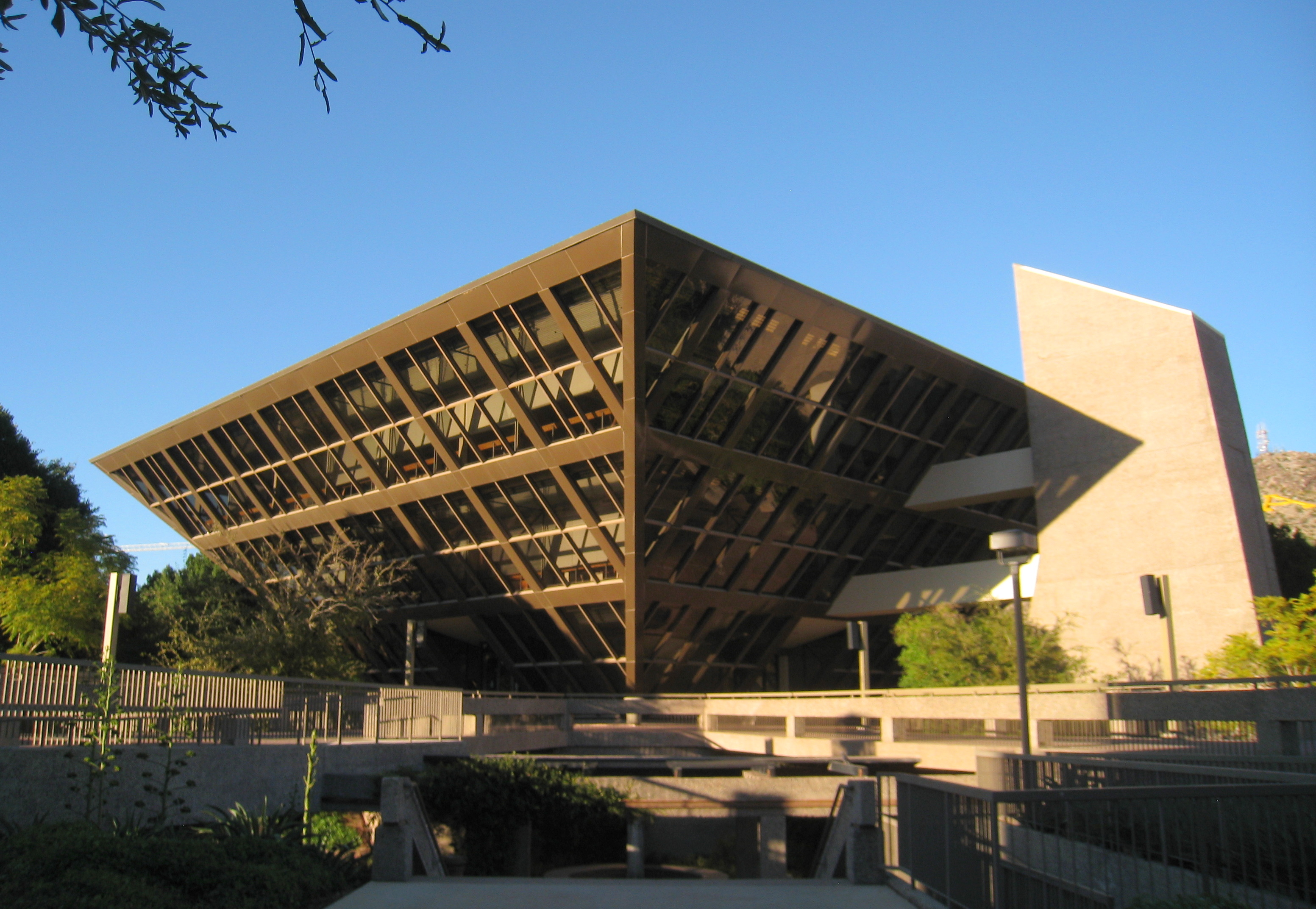
Meanwhile, to hear government officials and Wall Street tell it, the economy is recovering, and perhaps in the language of economics it is.  But in truth the ‘recovery’ looks something like an upside down Ponzi scheme, a bit like the Tempe, AZ City Hall.

All the wealth is at the top but there is little to support it down below–and unlike the architecturally brilliant building, the upside down economic pyramid must eventually fall down. We have almost pathological blinders when it comes to seeing the obvious perils to our continued existence–climate change and global warming, peak oil, water and food shortages, melting glaciers, species extinction, deforestration, floods, droughts, oceans under siege. But still we gulp the koolaid and believe that growth is good and things will be better soon.  And we are just as blind when it comes to understanding that commodifying the sanctity of corporate well-being over human welfare is ultimately our downfall, not the path to prosperity that it claims to be.

I don’t watch much television, but I guess I should because it seems there is a Tru Tv which claims to be, “television’s destination for real-life stories told from an exciting and dramatic first-person perspective.  “Not Reality. Actuality”.   The truth will not be televised, but television is truth. As for the American dream, it is the reality show to end all reality shows.  And in the finale, the truth will out, but unlike “Lost” or American Idol”, there won’t be re-runs and don’t hold your breath for a spin-off or a sequel.

———-

Note regarding dispersants:  Via the Times Online this is why these are so very dangerous.  I would add that we should be extremely worried about the impact on reproductive health on animals and humans as well:

“Dispersants can contain particular evils. Corexit 9527 — used extensively by BP despite it being toxic enough to be banned in British waters — contains 2-butoxyethanol, a compound that ruptures red blood cells in whatever eats it. Its replacement, COREXIT 9500, contains petroleum solvents and other components that can damage membranes, and cause chemical pneumonia if aspirated into the lungs following ingestion.

But what worries Dr (Susan) Shaw most is the long-term potential for toxic chemicals to build up in the food chain. “There are hundreds of organic compounds in oil, including toxic solvents and PAHs (polycyclic aromatic hydrocarbons), that can cause cancer in animals and people. In this respect light, sweet crude is more toxic than the heavy stuff. It’s not only the acute effects, the loss of whole niches in the food web, it’s also the problems we will see with future generations, especially in top predators.””

Share

My New Decade’s Resolution

Most years, my New Year’s resolutions are the usual mundane fantasy items– lose weight, spend less money, improve my love life, yada yada.  The other day however, I received a lovely little notepad that says, “I am fairly certain that given a cape and a nice tiara, I could save the World.”  Of course the author probably should have mentioned having a magic wand, but nonetheless, I was inspired to think that after the last ten abominable years, a decade-size resolution might be in order, so here it is:

TAKE BACK THE COUNTRY AND

SAVE THE WORLD

Cut to the chase, the last ten years have been a horror.  From the stealing of two Presidential elections to the events of Sept. 11, 2001, the wars first in Afghanistan and then based on outright lies, Iraq.  The fleecing of investors and non-investors alike by companies like Enron and Goldman Sachs.  Katrina, the economy, foreclosures, the healthcare debacle and the failure of substantive progress in addressing climate change.

Add to that a global perspective, and of course things are much worse-horrendous weather along the Pacific Rim, the ongoing hell of places like Gaza and Darfur, people starving and dying of disease unnecessarily, half a million maternal mortality deaths every year, melting glaciers, it was, let’s face it, a decathlon of disaster.

In a must-read piece about what is needed,  Ronnie Cummins of the Organic Consumers Association refers to those who run the government as “indentured politicians,”  a thought echoed by Carl Bernstein who knows a thing or two about crooked politicians.

Meanwhile in Beltwayistan

White House Chief of Staff Rahm Emanuel has been telling Democrats a win on the health issue will reverse the slide in public opinion, just as passage of another controversial proposal, the North American Free Trade Agreement, lifted President Bill Clinton in the polls.

And after all, it is all about public opinion…not.

Health insurers get some big presents in the Senate’s health overhaul bill — about 20 million new customers and no competition from a new government plan.Taking advantage of those boons might take some time, though.

The bill imposes hefty new taxes and coverage rules that will pinch insurers by forcing them to cover more sick people without gaining enough healthy, lower-cost customers, industry insiders say. The industry is also worried the bill doesn’t do enough to control health care costs.

It’s a matter of figuring out how to make those new customers profitable, analysts say.

However, the most damaging thing about the health care debate is not the legislation itself,  flawed as that is, but rather that those who have opposed meaningful reform have been allowed to hijack the discourse with tactics such as using the issue of abortion rights not only to weaken the legislation but to create such a lengthy ruckus that things such as the economy, military spending and most importantly the environment have been relegated to afterthoughts.

“We need to deal with the phenomena of global warming, but I think it’s very difficult in the kind of economic circumstances we have right now,” said Indiana Democratic Sen. Evan Bayh, who called passage of any economy-wide cap and trade “unlikely.”

At a meeting about health care last month, moderates pushed to table climate legislation in favor of a jobs bill that would be an easier sell during the 2010 elections, according to Senate Democratic aides.

“I’d just as soon see that set aside until we work through the economy,” said Sen. Ben Nelson (D-Neb.), “What we don’t want to do is have anything get in the way of working to resolve the problems with the economy.”

Leaving aside the absurdity of cap and trade, so nice to hear from you again Sen. Nelson after your sellout of women’s human rights in exchange for the health of the insurance companies, and now you would have us believe that the economy is going to get better while the environment falters?  Can I interest you in some oceanside property in Florida?

Translation of all this thanks to my handy B.S.-to-English translator:  We need to see past our noses when it comes to the word from Washington according to self-serving politicians such as Nelson, Bayh and Emanuel.  We may have voted these  folks into power, but the reality is, their loyalties are to themselves and their corporate owners.

Which leads me back to that super-sized resolution.  Enough already.  Why in tarnation are we allowing corporations to pull the strings?  Why is corporate welfare being valued over human rights? Why are we allowing the continued trashing and degradation of our planet? Where is the culpability?

I’ve written several times recently about the need to stand up for what you believe (here and here).  It is time to do some serious introspection and to think about what we truly believe in and what is important, and quite frankly, whether we plan to be able to look back upon the next decade 10 years from now because that is just how serious the issue of climate change is.  And then it is time to get off the couch.

We don’t have the luxury of waxing poetic while we watch the ball drop in Times Square.  We’ve already dropped the ball enough.  We need to be in the street, we need to go to Washington, and yes all that might mean going to jail, but no  way around it, we need to reclaim the body politic and we need to do it now.

Share

Nuclear Power Is Not The Answer

As we grasp at straws trying to find a way to substantively address climate change, some folks on the left who really ought to know better are touting the use of nuclear power as an alternative to coal, usually prefaced with, “I hate to say this but…”.

Nuclear power is neither safe nor cheap and solving climate change by killing ourselves off another way is just plain stupid. Aside from cost, there are 2 BIG problems with nuclear power:

1.  It has this ugly tendency to leak and explode and expose land and people to toxic radiation.

2.  There is no known safe way to reliably contain it or dispose of its toxic bi-products.

(F)inancial and energy journals make clear that boiling water with uranium is the costliest and dirtiest energy choice. Even Time magazine reported Dec. 31, 2008, “It turns out that new (reactors) would be not just extremely expensive but spectacularly expensive.”

Florida Power and Light’s recent estimate for a 2-reactor system is a shocking $12 to $18 billion. The Wall St. Journal reported on nuclear’s prospects May 12, 2008 finding, “[T]he projected cost is causing some sticker shock … double to quadruple earlier rough estimates. These estimates never include the costs of moving and managing radioactive waste — a bill that keeps coming for centuries.

Radioactive tritium has poisoned groundwater near at least 14 U.S. reactors, including Kewaunee in Wisconsin. Water under Braidwood, Dresden, Brookhaven, Palo Verde, Indian Point, Diablo Canyon, San Onofre and Kewaunee is all contaminated at levels above EPA and NRC standards.

Nuclear power is so clean that Germany legislated a phase-out of its 17 reactors by 2025. Germany’s 1998 decision was based partly on government studies that found high rates of childhood leukemia in areas near its reactors.

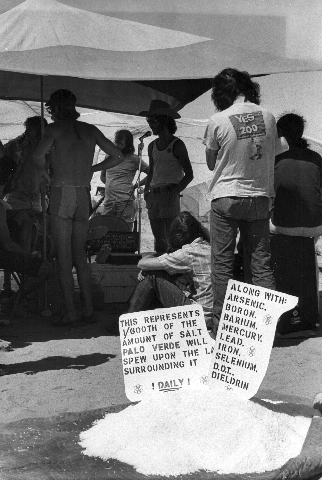
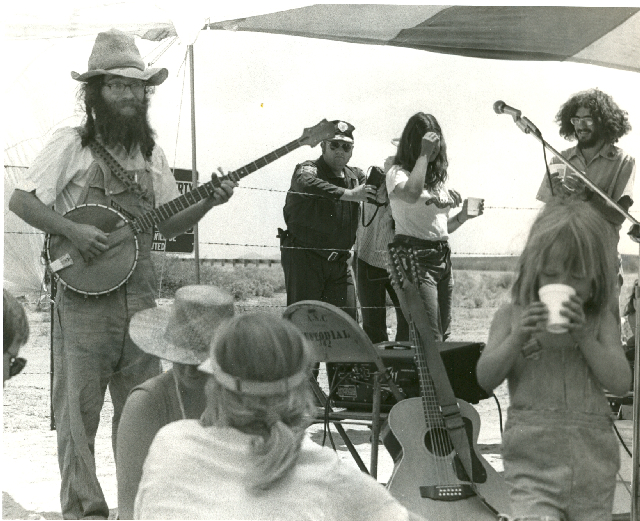
This article is personal to me because one of the very first protests I ever attended back in the early 1970′s was to stop construction of the Palo Verde Nuclear Power Plant outside Phoenix, AZ.

PaloVerde1

Palo Verde protest circa the 1970's.

We were a scruffy lot, gathered just outside the barbed wire fence that was the future Palo Verde site with law enforcement on the other side waiting to see if we would go  through the fence.  Both photos taken by yours truly.

We were a scruffy lot, gathered just outside the barbed wire fence that was the future Palo Verde site with law enforcement on the other side waiting to see if we would go through the fence. Both photos taken by yours truly.

We were right to be concerned then, and those concerns are still valid today. This is not a viable way to provide energy. It is toxic, it is expensive and while there is still the possibility of constructively addressing climate change, once the monster of nuclear pollution is unleashed, we will have committed planetary suicide.

Share

The First Church Of The Sidewalk

We’re having the wrong conversation, or perhaps more accurately, we’re having a lot of wrong conversations.

This past weekend, I joined a small group of people from across our community who felt moved to stand up against the escalation of the war in Afghanistan.  We chose to stand in a place where we have visited before in the cold December air–on the sidewalk next to the main road leading  to the biggest shopping malls in town because we knew people would have plenty of time to read our signs as they were stuck in traffic.  The traffic was lighter than it has been in past and several stores in the strip mall behind us have been shuttered in the last year.  No  doubt people heading into the malls will  be spending less this year, considering each purchase a bit more carefully.

A few people yelled angry things at us, most just stared, a few  honked and waved in support.  But they all kept driving.  Into the mall, with less money but refusing to see  the connection between the money we spend in Afghanistan, for what noble  cause (as Cindy Sheehan eloquently puts it) I have no idea.  In explaining the reasons for the escalation, Obama opened with references to 911, claimed that terrorists trained overseas had been found in America (although on  the Colbert Report a few nights later, Homeland Security Secretary Janet Napalitano was hard-pressed to offer any evidence of that, and the mainstream media sure isn’t pressing the point).  Obama’s  speech offered no change, in fact it could have  just as easily been  delivered during the Bush presidency. Telling us we must risk more lives to fight the elusive enemy called terror. And meanwhile,  Americans rack up credit card debt at the mall just in time for Wall Street to hand out its obscene bonuses.

Change?  Not hardly, just a propping up of the system so that it can keep feeding on itself.  Congress meanwhile bound and determined to pass a healthcare bill regardless of merits cheerfully sold out women’s reproductive rights in the eleventh hour for 3 votes and whatever the final form of what is likely to be a very sorry piece of legislation looks like, the compromises made in the name of health industry ‘support’ will no doubt come at the cost of lives, probably many more lives than have been lost to ‘terrorism’. Still, people keep driving to the mall.

But perhaps nowhere is the discussion more nonsensical than when it comes to the environment.  The whole notion of Cap and Trade is insane (and for a wonderful, easy explanation that even a grade-schooler (although apprarently not members of Congress)  would understand of why, go here).  Here in the southeastern U.S. our mountains have been sacrificed for coal, the tops summarily cut off and the debris  dumped in our streams as if we have the right to do  such a thing without regard for the true cost to people and the environment.

As Bill McKibben points out, this wrong conversation about the environment, unlike the wrong  conversations about the economy and health care, has the potential to be an end game, to wit physics does not know to respond to politics, “It’s like nothing we’ve ever faced before — and we’re facing it as if it’s just like everything else. That’s the problem.”

And still, people keep driving to the mall.  Back in 2002, as the war in Afghanistan was ramping up, we had a  sign in our yard that said, simply, “Peace”.  Some of my neighbors felt moved to respond by literally circling our front door with “We Stand With President Bush” signs. It was a terrifying sight. When the Christmas season rolled around again later that year, one of my sons wondered what would happen if we put a sign up that said “Peace on earth, Goodwill to all.”   In the years since, I have stood my peace several times alongside the malls as we did last weekend.  And in the last few weeks, I have stood up for health care, and for the environment.  And I’ll keep standing up. I think of it as attending the First Church of the Sidewalk, surely a far holier experience than a day at the mall.

The one thing I know for sure–we need to quit the annual mall trek, get out of our cars, put down the plastic shopping bags and say enough of the damaging and downright deadly conversations.  Health care is a human right, war does not create peace and most assuredly begets terrorism.  The wealth of corporations cannot come at the expense of the welfare of people and we can not trade our way to capping carbon or fuel our world by destroying mountains.

Stand up.  Speak out.  It is  time to insist upon speaking truth to power.

Share

Scenes From A Zipless Recovery

Dear Main Street Residents,

The recession is ending, no more worries, sorry for the inconvenience.

Love,

Your BFFs  on Wall Street

As the national economy starts its slow recovery, 11 states and the District of Columbia are showing signs of emerging from the recession, according to a new report. (from Moodys Economy.com via Stateline)

Moody’s also estimated that the national recession ended in August, although the National Bureau of Economic Research, a private research firm that calculates the official dates of recessions, has yet to declare the end of the current downturn.

But let’s just bear in mind where that rose colored pronouncement came from– according to a report from McClatchy,

The Securities and Exchange Commission issued a blistering report on how profit motives had undermined the integrity of ratings at Moody’s and its main competitors, Fitch Ratings and Standard & Poor’s, in July 2008, but the full extent of Moody’s internal strife never has been publicly revealed.

Translation:  I’ve got some swamp land in Florida for sale.  Well actually I don’t but can you blame me from trying to sell it to you anyhow.  If you want a more  honest take on the view from the top of the economic pecking order, this refreshingly honest commentary from a Goldman Sachs executive is probably more to the point:

“The injunction of Jesus to love others as ourselves is an endorsement of self-interest,” Goldman’s Griffiths said Oct. 20, his voice echoing around the gold-mosaic walls of St. Paul’s Cathedral, whose 365-feet-high dome towers over the City, London’s financial district. “We have to tolerate the inequality as a way to achieving greater prosperity and opportunity for all.” (Bloomberg)

Meanwhile, down the block on Main Street,  recovery NOT is still a happening event:

The official jobless rate — 10.2 percent in October

one out of every six workers — 17.5 percent — were unemployed or underemployed in October. (New York Times)

For black teens nationwide, the rate was 40.8 percent in September. (Chicago Tribune)

40.8%…just roll that number around in your brain for awhile. Then consider this:

U.S. companies increased their output in the third quarter even as they slashed working hours, driving productivity up at a 9.5% annual rate in the quarter, the Labor Department estimated Thursday. …

Productivity is output divided by hours worked. Output rose 4% annualized, while hours worked plunged 5%. Real hourly compensation increased at a 0.2% annual rate. (Market Watch via Daily Kos)

If you look in your Berlitz for Wall Street-ese, that translates to, ‘we worked harder for less hours to make more stuff which we can afford less because we
earned less or worse yet, lost our job. And here’s a little conjugation of the screw you verb translation above,

Credit card companies are rushing to increase interest rates to historic highs of more than 30 percent, cut credit limits, and add new fees, even for customers who pay their bills on time. (Boston.com)

And then there is the pesky matter of health care and the ‘reform’ that is supposed to  cure it:

According to research by the John Hopkins Children’s Center, an analysis of 23 million hospital records from 37 states shows that a lack of health insurance likely played a role in the deaths of nearly 17,000 U.S. children over a 17-year period. (Denver Post)

One wonders if “children not covered” is a line item in annual reports by insurance companies which just had a VERY profitable quarter:

Managed care company Cigna Corp.’s third-quarter profit soared 92 percent, as improving equity markets spurred a big turnaround in a discontinued business that hurt the insurer last year.

Don’t know about you, but I sure the hell can’t sleep at night with that.  And lastly, give a big cheer for the ever so Gross Domestic Product that rose a “better than expected” 3.5% in the third quarter.  And here is one reason:

Billed as a way for the government to put more fuel-efficient vehicles on highways, the popular $3 billion Cash for Clunkers program mostly involved swaps of old Ford or Chevrolet pickups for new ones that got only marginally better gas mileage, according to an analysis of new federal data.

The single most common swap — which occurred more than 8,200 times — involved Ford F150 pickup owners who took advantage of a government rebate to trade their old trucks for new Ford F150s. They were 17 times more likely to buy a new F150 than, say, a Toyota Prius. The fuel economy for the new trucks ranged from 15 mpg to 17 mpg based on engine size and other factors, an improvement of just 1 mpg to 3 mpg over the clunkers.

The overall mileage increases over the clunker fleet represent a decline of 1.87 million tons of carbon dioxide per year, based on families driving an average of 12,000 miles, a yearly savings equivalent to the amount of carbon dioxide spewed in the U.S. in just 2.5 hours. (AP)

(Note–To get a further idea of just how absurd this program was, during the Cash for Clunkers program, I traded in my 10 year old van that was beginning to have significant problems  for a car that gets much better milage.  However since my van officially got  19 mph, I didn’t qualify for the program, even though my new car is far more efficient than some of the trucks and SUV’s that qualified for the rebate.  And while it gave a huge short-term boost to auto sales, it is doubtful that will have a long-term impact and the more important question is why boosting the auto industry without a significant change in transportation policy is appropriate in the first place.  Yes jobs are at stake, but this kind of short-term thinking is not going to save those jobs in the long run.)

Dave Lindorff has a more detailed explanation,

Most of that rise was the result of government subsidies to car-buyers and first-time house buyers. It was a one-shot stimulus that pushed forward spending, but it was no indication of a recovering economy, just a spasm of spending using taxpayer money. Furthermore, an excellent article in Businessweek by Michael Mandel noted that fully one-percent of that GDP gain was the result of a failure by government economists to account for a collapse in corporate spending on research and development and on training and retaining intellectual assets (a complicated way of saying that engineers, scientists and technology workers were being laid off at a higher rate than other workers, and much R&D work was being shipped overseas for good), So really the “growth” of GDP in the third Quarter should have been at a 2.5% rate, and even that was largely government pump priming, not recovered economic activity.

So what to take away here?  First of all, let’s quit using the DOW as a measure of how things are.  As Lindorff points out apropos of the oft repeated ‘wisdom’ that employment is a lagging indicator,

High and pro-longed unemployment leads to reduced demand for goods and services, and to a psychology of fear and consumer withdrawal. Once people feel that they aren’t going to find a new job soon, and once those who still have jobs feel that their employment is not secure, they no longer buy things except what they absolutely need. And in an economy where fully 72% of economic activity is consumer spending, that is no longer a “lagging indicator.” High, prolonged unemployment becomes a causal factor in the economic downturn.

In other words, sooner or later (and I’m betting on sooner), there is  going to be major blowback on Wall Street.

In our current  economic system, the official barometer of whether we are economically healthy or not is based primarily on the health of corporate citizens, not human ones.  Don’t have insurance, a job or a house? No worries, the market is up.  Which really should give us pause to think that maybe, possibly, we are measuring the wrong stuff.

As all of the above should certainly serve to illustrate, the current discourse on the economy is delusional.  If we are  truly to ‘recover’ in a meaningful way, we will need to re-define what we consider as economic well-being. Imagine how our policies might be different if, as Riane Eisler suggests, we measured the value of caring.   Or if we gave to meet needs instead of assuming the necessity of an exchange of goods as Genevieve Vaughan suggests.

And while I am not going to address it in depth here, any sustainable economic policy must also take into account and be responsive to the issues of climate change and global warming.  We cannot continue to degrade the planet at will and we need to take immediate steps to address the changes that are already happening.

Until we make those paradigm shifts in the way we think about the economy, the rumors of its recovery should be considered as the poppycock that they are.

———-

Postscript–Lest there is any doubt–the title of this post traces it’s origins to Erica Jong’s Fear of Flying,

The zipless fuck is absolutely pure. It is free of ulterior motives. There is no power game . The man is not “taking” and the woman is not “giving.” No one is attempting to cuckold a husband or humiliate a wife. No one is trying to prove anything or get anything out of anyone. The zipless fuck is the purest thing there is. And it is rarer than the unicorn. And I have never had one.

–Erica Jong, Fear of Flying (1973)

Share

The Real Failure And What We Choose To Do About It

I went to see Where The Wild Things Are over the weekend, highly recommended although the beginning of the film ironically adds scenes that the film’s producers apparently imagined Sendak must have been thinking were the catalyst for this flight of fancy instead of Sendak’s quite plausible story line because it could not possibly be a commercial success I suppose unless you add some big bad mean teenage sister and her evil friends and a single struggling Mom who just needs affection herself.  Which unfortunately takes an elegant tale and makes it both problematic and unsuitable for younger children, for whom the book was written in the first place.

Okay, so maybe that is a rather qualified recommendation. Even so, I still greatly enjoyed the film.  But after coming home and re-reading the book, I started thinking about the point that regardless of where our flights of fancy lead us, sooner or later we need to come back to reality.  Which of late here on Planet Earth pretty much sucks.

The following morning as I was reading through the Sunday newspaper, I realized that the pile  of newsprint that was devoted to trying to sell me something I probably don’t need was far larger than the part devoted to informing me of the publisher’s take on what is so.  As an example, there were any number of ads hawking beverages in plastic bottles, but nowhere a reference to a recent report that,

Drinking water from plastic bottles made with the toxic chemical bisphenol A (BPA) increases urinary levels of the chemical by nearly 70 percent, according to a study conducted by researchers from Harvard University and the Centers for Disease Control and Prevention.

BPA, an industrial chemical that makes plastics hard and transparent, is widely used in plastic drinking bottles, infant bottles and other consumer products, and also in resins that line cans of food and infant formula. The chemical has been shown to disrupt the hormonal system, potentially leading to reproductive defects as well as brain damage, cardiovascular disease, cancer, obesity and diabetes.

Nor among all the glossy pictures do we see this:

On a daily basis, we are bombarded with a veritable avalanche of data that skewers our perceptions of what is real and what is important.  Not only that, but the historic context in which we process this bombardment is skewered as well, something that is made elegantly clear in the reading of From Eve to Dawn, Marilyn French’s history of women, or Riane Eisler’s The Chalice and The Blade, or other documentations of women’s lives and history that has been marginalized in the telling of our stories over the years (and ditto that point regarding the history of anything that isn’t pale and male).  As Corinne Kumar makes clear in this elegant speech, to truly attain social justice, we need to understand the roots and depth of the human condition, and that has been rather literally bleached out of history.

Which brings me to this–While the U.S. is operating, or more to the point not, on the assumption that our national decision-making must be  predicated on  the theory that mega banks and insurance companies are too big to fail, that corporate welfare must be preserved even at the cost of human welfare becoming a toxic asset, Richard Power points to the real show-stopping questions of whether the climate and human race are too big to fail, saying quite pointedly that if we don’t get a grip on climate change,

Goldman-Sachs and its ilk won’t be our biggest problem, or even among our top ten problems.

If the planetary climate is allowed to fail we will be circling back to

No longer too big to fail...Summer ice in the arctic will likely be gone in 20 years.

No longer too big to fail...Summer ice in the arctic will likely be gone in 20 years. But consider the amount of news coverage this story has gotten compared to the boy who didn't go up in the balloon.

the beginning of Kubrick’s 2001: A Space Odyssey, i.e., just a bunch of armed apes. Indeed, it is not just the future that we are in danger of losing but also the past.

As for the human race,

After all, it’s us, it’s all we’ve got.

But as Power eloquently documents, that point seems to be completely forgotten when it comes to things like our policies on issues such as Darfur or empowering women. Here in the U.S. we have been having an obsessively myopic national angst attack regarding the financial and health industries and our national ‘security’ at the expense of almost everything else–the environment, education, etc.

If indeed we continue to insist on measuring success by corporate wealth and how much stuff we make and buy, Goldman Sachs will continue to thrive.  For awhile.  But in the end, human beings and the climate will, inevitably, fail.

Does it have to be that way?  Honestly, I no longer feel any certainty that we can stop it from happening, we may well be beyond the tipping point.   But one thing is for damned sure, we don’t have to continue to contribute to our own demise.  There are many efforts being made to change our values paradigm to reflect the world that is really so. One very exciting new initiative is The Real Wealth of America Public Policy Project, based on Riane Eisler’s, “The Real Wealth of Nations” which,

is designed to advance the real wealth of our nation: the health, well-being, and full development of our nation’s women,  men, and children. A major aim of the project is to change the present economic  perspective to one that not only recognizes the enormous “back-end” financial costs of  failing to invest in people, but also recognizes the direct economic benefits of investing in
human capacity building.

As Eisler states: “Rather than trying to just patch up a system that is not sustainable, let’s use our economic crisis to move to an economic system that really meets human needs. As Einstein said, we can’t solve problems with the same thinking that created them. In our time of rapidly changing technological and social conditions, we must go deeper, to matters that conventional economic analyses and theories have ignored. We need a caring economics that no longer devalues the most important work: the work of caring for people, starting in early childhood, and the work of caring for our Mother Earth.”

The indicators for the currently used Gross National Product were developed and adopted  during the depths of the Great Depression. They were only meant by their authors to be a beginning for measurements, not the be all and end all.

We urgently need new economic indicators. The RWA public policy project is a strategic step toward achieving this goal.

The governing values for measuring and promoting the Real Wealth of Nations are:

  • Recognizing that the contributions of people are the real wealth of a nation– and hence the need to invest in human capacity development, starting in early childhood.
  • Recognizing that, especially for the post-industrial knowledge-information economy, our most important capital is high quality human capital.
  • Recognizing the need to give greater visibility and value to the work of caregiving in both the market and non?market economies.
  • Recognizing the value of investing in our human infrastructure for our world’s families, communities, equality, democracy, and economic success.

It is precisely this kind of thinking that is absolutely critical if we are to make the paradigm shift necessary to avoid presiding over the biggest failure of all, our own and that of Mother Earth.  I have a recording of Phil Och’s song “I Ain’t Marching Anymore” where he introduces the song as a “turning away song”.  Turning away is a very powerful statement and we  need to do a lot more turning away, from greed, from exploitation, from violence and hate.

We need to say no more, but we need to go beyond that–we need a change of direction such as Eisler is suggesting.  We need to do this on a personal level and on a societal level.  On October 24th, there will be a Global Day of Climate Action with events all over the world.  Find out what is going on where you live and make plans to be there, support The Real Wealth of America Public Policy Project, find  and support other projects that are path-changers. As Alice Walker so beautifully observes, we are the ones that we have been waiting for.

Share

A Plea For The Planet

In observance of Blog Action Day for Climate Change below are excerpts from several articles that I wrote in 2005 and 2006.  I haven’t written much about the environment since then, because writing what I know to be so in this case is simply too painful and difficult to write.  When I went back and re-read these pieces, I found that sadly, they are  still valid today, in fact even more so with the evidence of global warming and climate change that has been gathered in the interim.  And so, I again share with you these thoughts and implore you to take these words to heart.

From There Is No More Time (March, 2005):

All evidence suggests that our lives and that of our planet are in grave peril. If we are to survive, we must immediately dismantle the forces of greed and power that are destroying our lives in the toxic pursuit of empire. It is our refusal to face the realities of global warming and our continued illegal use of Depleted Uranium that are the true terrors of our time. Our governments and the corporate empires they defend must be compelled to cease and desist from all forms of violence against our earth and its inhabitants, to work towards mitigating the damage done and to begin creating a livable future.

The environmental imperative of our situation cannot be ignored. The impact of global warming is accelerating. Levels of carbon dioxide (the main cause of global warming) have risen abruptly in the last two years. The Arctic is warming twice as fast as the rest of the world and its polar ice cap has shrunk up to 20% in the last three decades; the ice cap is expected to disappear altogether by the year 2070.  Our land, air and water are polluted with toxins and waste to the point where they can no longer sustain life. Species of plants and animals are becoming extinct, glaciers are melting.

As global warming continues to affect the life of our planet, the results will be devastating. Water will become scarce in some parts of the world while others will be flooded by rising seas as the polar ice caps melt. Rain forests are likely to dry out and burn and parts of the world will become much hotter even as others become much colder. Droughts will cause starvation, oceans will become more acidic and less hospitable to life and diseases like malaria will spread easily.

Studies and reports have been issued telling us that temperatures are rising far faster than previously thought and that we have reached the tipping point in global warming that we had sought to avoid. There is the grave possibility that within as little as 10 years, we will reach the point of no return. Once that point is reached, the risk of abrupt uncontrollable climate change is expected to increase according to the recent report “Meeting The Climate Challenge”.

Each year, more and more people die unnecessarily of the cancerous impact of our toxic behavior, of preventable starvation, of disease and because of the misguided priorities of violence. War rages because of greed and the desire for domination. The pandemic quest for power and honor cuts an ever-widening swath of violence and degradation. Millions of people have been killed, wounded, trafficked, sexually assaulted and left homeless. And always, it is women and children who are most victimized.

It is precisely our disconnection from our ecological support systems that allows us to commit warfare.

It is the most perverse of ironies that the military forces that claim to defend us are responsible for most of the violence and environmental degradation that is destroying our world. These forces are inextricably tied to the ethos of corporate and national empire building that values the hoarding of resources over the common good.

This perilous and lethal greed is no longer tolerable and it is imperative that we come together in insisting on an end to planetary destruction and full commitment to creating a fair and sustainable future, with full and equal voice for all, most especially those who have born the brunt of the impact of the patriarchal irresponsibility.

Delay is no longer acceptable or possible, there is no more time.

We’re Melting (in its entirely) (December, 2005):

One wonders what the Wicked Witch of the West must have been thinking in that terrifying moment in the Wizard of Oz after Dorothy doused her with water, when she realized that she was melting and no amount of evil spells was going to change that? With the recent deluge of melting glaciers and warming seas, it seems we residents of planet Earth may be reaching a very similar moment.

Our glaciers are melting at an ever quickening pace and there seems to be little we can do to stop it. According to recent studies, the Helheim glacier, one of the largest in Greenland, is melting at a rate much faster than expected. If it continues, Greenland will likely become much smaller and SEAS COULD RISE AS MUCH AS THREE FEET DURING THIS CENTURY. The accelerated melting is attributable to Greenland’s warming temperatures which have risen five degrees Fahrenheit in the last ten years.

One of the most critical side effects of glacial melting is the threat posed to the Gulf Stream which could be shut down by the rising ocean water levels. The Gulf Stream protects Northern Europe from freezing temperatures. THE LAST TIME THE GULF STREAM FAILED, BRITAIN WAS COVERED IN PERMAFROST FOR MORE THAN 1000 YEARS.

A new scientific report by British oceanographers found that the overall movement of the Gulf Stream seems to have slowed down by 30% in the last fifty years. The slowdown is caused by increased glacial melting and warming ocean temperatures. While this has long been expected, scientists are alarmed to see these changes so soon.

Unfortunately, Greenland is only one of the many areas where glaciers are melting. In the Himalayas, whole villages are being destroyed by floodwaters from lakes overflowing with water from melting glaciers. Glacier lake catastrophes used to happen once a decade, now they occur every few years.

Ultimately the Himalayan glaciers will shrink to the point that their meltwaters will die out and the rivers that have been fed by the melting will all but evaporate, causing a severe shortage of drinking and irrigation water. Hydroelectric plants that supply power to the region will also be affected. The region is already experiencing a loss of vegetation that in the long term could lead to starvation for the region’s population.

Ice in the Arctic region is melting as well. If current warming trends continue, WITHIN 100 YEARS THE ARCTIC MAY BE ICE-FREE IN THE SUMMER, something that has not happened in a million years. The melting ice in the Arctic bodes badly for polar bears, seals and other animals in the region.

What scientists stress in all of these situations is that the process of melt-off has reached such a level that it may well be unstoppable; we may be at a point of needing to adapt and respond to the very harsh realities of global warming. A chilling thought.

We are already feeling the impact of global warming in a number of ways. Rising ocean temperatures have caused what scientists term a catastrophic drop in sea and bird life numbers in the Pacific Northwest. Populations of seabirds such as cormorants and fish such as salmon and rockfish are at record lows. Similar events are taking place in the North Sea.

In addition to the impact on our oceans and seas, a recent report found that CARBON DIOXIDE LEVELS ARE THE HIGHEST THEY HAVE BEEN IN 650,000 YEARS. The World Health Organization has found that 150,000 DEATHS AND FIVE MILLION ILLNESSES ARE DIRECTLY ATTRIBUTABLE TO GLOBAL WARMING.

But that’s not the bad news. The bad news is that these stories tend to get buried on page A18 of the newspaper (if they’re covered at all), pre-empted by the latest car accidents, political foibles and other human interest stories.

Climate change should be a Page One headline and at the top of our national agenda as well. Yet our media refuses to connect the dots and we have elected leaders who seem to think we are exempt from global reality. No need to act, just stay the course and keep driving those SUVs up the river De-Nial.

One wonders what part of deep brown smelly stuff our media and pols fail to grasp? Do we perhaps need to send the lot of them to see “Chicken Little” so that they can practice saying, “The sky is falling, the sky is falling”?

No, best to leave our heads firmly planted in the sand.

From How Hot Does It Have To Get (January, 2006):

My new calendar has a picture of an ice-covered Alaskan wilderness preserve. My throat catches every time I glance at its breathtaking beauty, and I make a mental note to go see this beautiful place soon, before the ice melts.

It is no longer possible to relegate global warming to a theoretical possibility. It is reality. It is 60-degree days in January when it should be six degrees above (in the city where I live, temperatures are running more than ten degrees above normal this month). It is the slowing Gulf Stream, the melting ice. It is the droughts in Africa and Oklahoma, in the Himalayas and the Amazon. It is the rising seas and hurricanes and tsunamis that decimate cities and villages in Indonesia and Louisiana. It is the highest carbon dioxide levels in 650,000 years and the fish and plankton that are dying in the warming seas.

There is no real doubt that this is occurring, only the political impossibility of admitting that not only is it happening, but it is not within our power to stop it, the changes that we are seeing have taken on a life force of their own. It is the life force that our earth has always had, which for a few brief years in the history of the universe, we delusionally thought we had the power to overcome. But the truth that we are faced with now is that it was never ours to control, and our biosphere, our planet, our world has once again taken the reigns in what is to be. Climate change has accelerated to the unstoppable point of no return. The snowball is now an avalanche.

Weather events like last year’s Tsunami and the hurricanes of last fall are surely just a preview of what is to come. Yet we stupidly declare that we can rebuild New Orleans from the ruins of a bayou covered with toxic sludge without more than a cursory examination of the damage done or whether it will ever truly be safe to live there again. We rebuild, stubbornly clinging to the notion that we are the masters of our environment. It does not yet occur to us that it has been a mortal mistake to think that it was ever ours to command.

It is time to make peace with our planet, to apologize for the damage done and to humbly ask for a chance to tend our hearth with mercy, even if we can no longer make amends.

Share