There are many ways in which to describe the oil rig explosion in the Gulf of Mexico. Any of the following will do:
Ecotastrophe
Disaster
Greedy, Criminal Corporate Arrogance
But spill? Not so much.
When I think of a spill, I think of this:
NOT this:
What happened should not be allowed to be framed in terms of oops, my bad. It is the catastrophic aftermath of the perfect storm that is the result of our very failed national energy policy and the persistent prioritizing of corporate greed over the public good.
The gulf oil disaster is beginning to become a predictable story–too little oversight, lax laws (and if you want to know why, just follow the money), profit over environment rather literally blows up in our faces and we got nothing except a lot of Congressional hearings, hand-wringing, brow-beating and good old fashioned buck passing, maybe a quick trip to bankruptcy court which will lead to lack of financial culpability and then surprise surprise, BP will be back to profitability in no time while the fishing and tourism industries die, along with the flora and fauna and we’ll keep drill baby drilling. Another episode of mourning in America and still we don’t get that this can’t continue.
Tennessee Coal Ash Disaster 2008--They called that a "spill" too.
__________
I saw a story this morning about the media being denied access to the disaster response headquarters which makes me grateful for the media heroes who are determined to tell the truth even if they do get turned away at the door. Watching Alabama resident John Walthen’s fly-over video of the slick reminds me of the citizen videos of the Tennessee coal ash disaster, absolute environmental destruction.
In Walthen’s words,
“At nine miles out, we began to smell the oil… What I see on the horizon–nothing but a red mass of floating goo.”
Watch Walthen’s devastating video. And then cry. And scream. Do not let BP and Halliburton, or the government or the media push this story to the back page, do not let them frame it as an accident, a spill. It is neither of those 2 things–it is an eco-catastrophe caused by negligence and greed, no matter what the snake oil salesmen tell us.
On the morning after the British election Yahoo ran a headline that read, “‘Political vacuum’ sparks market jitters”. Just what we need after the Dow does a stomach tossing dive.
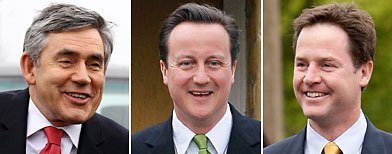
Only for sure thing--a pale white guy will be the next British PM
Should ‘market jitters’ indeed be a cause for concern after a day when the market plummeted? Yes in the sense that it has the potential of further destabilizing the already dicey European markets. But… My local paper ran a headline about yesterday’s Dow fiasco that read, “Dow plunges on Greek crisis, P&G sell order.” Truth–the market plunged because those events apparently triggered a bunch of algorithmic computer-driven sell orders that effectively fed upon each other and that is what really caused the market to plunge. In other words, a bunch of computers came perilously close to plunging the already fragile world economy into a death spiral.
For months now, I’ve been trying to understand how the market could keep going up when down here on the ground, things basically suck. Too many of us are poor, hungry, unemployed, sick and homeless. There is a huge disconnect between the health of the DOW and the health of the economy. What really hasn’t been discussed in depth yet is the impact of the mounting number of huge natural and unnatural disasters on our economic equilibrium; the utter destruction of entire countries in the aftermath of earthquakes, volcanoes that cost the airlines billions and utterly disrupt the transport system that we have become dependent upon.
And now the British Petroleum/Haliburton trashing of the Gulf of Mexico. A look at the long-term impact of the Exxon Valdez spill is instructive:
Three years after the 11 million-gallon spill in Prince William Sound blackened 1,500 miles of Alaska coastline, the herring on which he and other Cordova fishermen heavily relied disappeared from the area. Platt and some others stuck around, fishing for salmon and hoping things would improve.
The herring never returned to Cordova. Platt’s income plummeted, severely straining his marriage and psyche. He dipped into his sons’ college funds to support his family…
…The herring loss alone has cost the region about $400 million over the past 21 years, according to R.J. Kopchak, a former fisherman who is now developmental director at Cordova’s Prince William Sound Science Center.
The average fisherman suffered a 30 percent loss in income after the spill, but those who specialized in just herring lost everything, Kopchak said.
It is a fair assumption that tourism dollars will plummet along the Gulf and maybe up the eastern seaboard, unemployment in those states will rise, and if you take fish oil for your heart, the price is going up. And then there is the price that cannot be calculated for destroying ocean and wetland habitats, damage that can never be undone.
The HAL 9000
There are lessons to be learned from oil slicks that spiral out of control and computer programs that take off on their own (shades of Stanley Kubrick’s HAL) and make no mistake about it, these things are going to keep happening but unlike a roller coaster where you know that after the big plunge, the ride will go back up, here on planet Earth, there is no such guarantee. Time to fasten our seatbelts.
Hello U.S. media? Why exactly am I reading this story because of a link on Buzzflash to a blog that quotes a British newspaper?:
The good old days no more: "Come listen to a story about a man named Jed A poor mountaineer, barely kept his family fed, Then one day he was shootin' at some food, And up from the ground came a bubblin' crude. Oil that is, black gold, Texas tea."
The US military has warned that surplus oil production capacity could disappear within two years and there could be serious shortages by 2015 with a significant economic and political impact.
The energy crisis outlined in a Joint Operating Environment report from the US Joint Forces Command, comes as the price of petrol in Britain reaches record levels and the cost of crude is predicted to soon top $100 a barrel.
“By 2012, surplus oil production capacity could entirely disappear, and as early as 2015, the shortfall in output could reach nearly 10 million barrels per day,” says the report, which has a foreword by a senior commander, General James N Mattis.
It adds: “While it is difficult to predict precisely what economic, political, and strategic effects such a shortfall might produce, it surely would reduce the prospects for growth (emphasis mine) in both the developing and developed worlds.
They are still concerned about growth? Talk about epic delusional understatement, survival might be the more relevant consideration. But hey, what me worry, think I’ll just drive over to the nearest java infusion station and read the local paper so I can learn which hunky guy is misbehaving with which starlet, but first I’m going to send some money to support independent media and you should too. Gotta have your priorities.
There is so much to say about the the oil that is being spewed all over the Gulf of Mexico. Calling it a spill is a misnomer, that is what you say when a child accidentally tips over a glass of milk. This is an act of national and corporate terrorism. But still, Americans will buy gas for their cars at BP and I don’t hear Obama saying there will be a freeze on Halliburton contracts.
‘Experts’ are saying the the disaster ‘may’ cost upwards of $14 billion. No may about it, it will. Not only is there the environmental damage, we need to realize that the economy of the gulf shore is clearly shot to hell for the foreseeable future, energy prices will no doubt rise, and we already have a vulnerable economy. You add that up. And BP’s promises to pay for it, yeah, right.
Meanwhile in Massachusetts, the folly of our lack of attention to infrastructure is once more bearing fruit,
The oil, the water pipe–these are disasters for which we have only ourselves to blame. But even if we suddenly became exemplary planetary citizens, the volcanic eruption in Iceland a few weeks ago that brought the European continent to a standstill reminds us that our future would still not be ours to control.
Perhaps Margaret Atwood has already described what may happen in The Year of the Flood, –the silent flood, a disaster of epic proportions, human-made or not (it doesn’t matter in the end) that we don’t see coming and is beyond all of our fancy science and technology.
Only time will tell, but I don’t think it will take too long.
———-
“But love of the wilderness is more than a hunger for what is always beyond reach; it is also an expression of loyalty to the earth which bore us and sustains us, the only home we shall ever know, the only paradise we ever need – if only we had eyes to see.” —Edward Abbey
Today, Rainforest Action Network (RAN) hosts PUT CHASE ON THE RUN, a social media day of action, to convince Chase bank to stop funding mountaintop removal coal mining in the Appalachian Mountains.
JP Morgan Chase is the biggest U.S. financier of Mountaintop Removal (MTR). Mountaintop removal is the highly destructive mining practice that blows apart the tops of mountains in order to access coal in the cheapest way possible. MTR has buried over 2000 miles of rivers and streams and destroyed nearly 1.2 million acres of the Appalachian range. MTR has severely contaminated the air and drinking water, causing increased rates of mortality and disease for local people in the mountains of West Virginia, Kentucky, Tennessee and Virginia.
Join dozens of organizations and thousands of online activists in convincing Chase to stop destroying American mountains. Take a simple action on your Facebook, Twitter, Flickr, YouTube, blog or email to end mountaintop removal in 2010. Go to www.DirtyMoney.org for instructions and PUT CHASE ON THE RUN!
MTR has destroyed nearly 1.2 million acres of Appalachian forest and mountains
MTR has buried over 2000 miles of rivers and streams with debris and pollution
Tap water in many Appalachian communities is not safe to drink due to coal contamination
MTR techniques resulted in a 29% loss of jobs from 1987-1997, even as coal production rose 32%
JP Morgan Chase is the biggest funder in the U.S. of mountaintop removal coal mining
———-
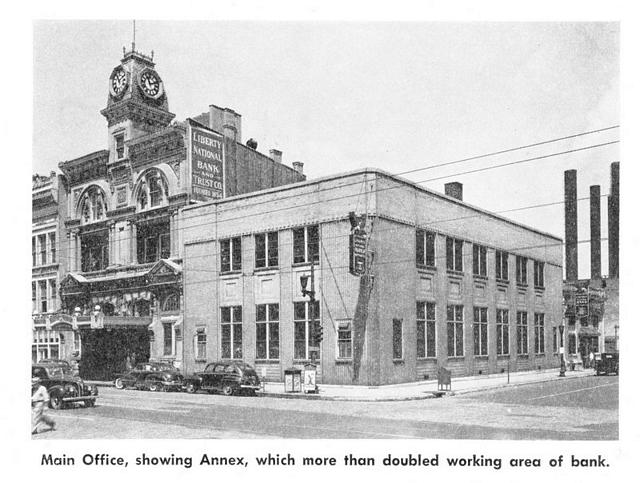
This story is personal for me. Aside from the fact that I can think of few things more heinous than cutting off the top of a mountain and dumping it in a stream along with all the pollution of land, air and water that goes with it, not to mention the horrendous economic damage done, I have an account at JP Morgan Chase. I didn’t used to. When I moved to Louisville 20 plus years ago, I opened an account at a branch of Liberty National Bank that was just down the street. And check out this lovely picture of their downtown office. It was sort of like the bar in Cheers–everyone knew your name. Then Liberty was bought by Bank One and that in turn was swallowed by Chase. It never occurred to me to look into the politics of what they do with money until now, but I am deeply offended and angry. You are not being a good citizen of this state if you are destroying it. The little branch office where I go still maintains the Cheers-like familiarity but when you look beneath the surface, it doesn’t feel so friendly anymore.
It is a major pain in the ass to move your bank account, especially when you have things on auto-pay as I do. I would prefer not to have to waste my time with all that. What I do plan to do is take a copy of this post with me the next time I go to the bank and give it to the branch manager and if you have an account at Chase, I urge you to do the same. It is not okay for big banks to come into our communities and destroy them (and Chase has a pretty nasty record with home foreclosures too), and they don’t need our loyalty, even after 20 plus years, if they do so.
Several years ago, in an effort to make sure that I had no excuse for not getting enough exercise, I bought a treadmill. Multi-tasker that I am, the plan was that I would do catch up on my inevitably overflowing reading pile while doing the cardio-vascular thing. Turns out that I am not one of those walks and chews gum let alone runs well with scissors types. So I broke down and started to watch television while I exercise.
Before going further, I should perhaps share that I didn’t watch much television as a child, an hour a day at most, well below today’s norm. We didn’t even have a color television until I was almost in college, not that we couldn’t, it was just deemed unnecessary. After I graduated college and got my first apartment, one of my first purchases was a small television. I actually bought that before I bought a bed or a table. And I sat down and watched it. And watched it. I watched soaps, I watched Dallas. The cheesier the better. This went on for a few years. And then I was over it and since then, my limited television watching, by national standards, has been practically unpatriotic.
But now thanks to my treadmill, I am catching up with what makes America tick, and it isn’t pretty, and I”m not even watching Fox (it might get my heart rate up a bit higher, the gastro-intestinal risk is just too high). While there is no shortage of edifying entertainment options out there , I’m finding the advertisements far more interesting. For instance, after a lifetime of being told to worry if my butt is too big, now there are undies that make your butt look bigger.
Not only that, but ‘news’ programs that you are supposed to take seriously actually spend time analyzing if this is a good product or not.
This is serious stuff, it is our ticket out of economic malaise according to Robert Reich who tells us that we need to spend if we are going to recover:
The truth, of course, is that the most important fiscal indicator is the ratio of the debt to the GDP. And the most important issue there is how quickly America can get jobs back and the GDP growing again. More spending in the short term is the only way to accelerate a jobs recovery, and reduce the debt-GDP ratio over the longer term.
So spend, baby, spend, get that 2nd pair of Booty Pops free, you just have to spring for the extra shipping and handling. But first we might want to do a wee bit of thinking about the economy those fancy new undies are helping to save.
First the good news, at least if you happen to work in the top echelon of a large financial institution:
Major U.S. banks and securities firms are on pace to pay their people about $145 billion for 2009, a record sum that indicates how compensation is climbing despite fury over Wall Street’s pay culture.
An analysis by The Wall Street Journal shows that executives, traders, investment bankers, money managers and others at 38 top financial companies can expect to earn nearly 18% more than they did in 2008—and slightly more than in the record year of 2007. The conclusions are based on an examination of securities filings for the first nine months of 2009 and revenue estimates through year-end.
earned $11.7 billion last year, more than double its profit in 2008, and generated record revenue. The bank earned $3.3 billion in the fourth quarter alone.
on Friday announced a record $9.3 billion payday for its investment-banking employees, setting the stage for competitors like Goldman Sachs Group Inc (GS) to also make eye-popping payouts. On a per employee basis, JPMorgan investment bankers, sales staff and traders, on average, are set to make about $379,000 for 2009, up more than $100,000 from 2008, when the broader financial sector was mired in crisis.
“People looking at it from the outside look at the dollars and say they are high,” said Kenneth Raskin, the head of law firm White & Case. “There is no question the dollars are high. The question is whether they were deserving.“
No, actually the question is how do these people live with themselves and why has this been allowed to happen. Based on the above, they earned as much as $279,000 a piece in 2008 while the economy imploded. There is no question of whether they are deserving. They are not, and no amount of Booty Pop wearing women is going to make them look better. Incidentally, according to the same article, median U.S. household income in 2008 was $50,303.
Consumer inflation was tame in 2009, with prices rising 2.7 percent. Yet families felt squeezed as their spending power sank in the face of falling wages, job losses and higher prices for energy, medical care and education.A surge in energy prices last year offset the biggest drop in food costs in nearly a half century.
The Labor Department says its Consumer Price Index rose a modest 0.1 percent in December. Excluding food and energy, prices were also up just 0.1 percent last month.
The Commerce Department said on Thursday retail sales fell 0.3 percent last month, the first decline since September, as consumers spent less on vehicles and an array of other goods during the holiday shopping month.
Analysts had expected an increase of 0.5 percent, but disappointment was tempered by upward revisions to prior months’ data. November sales were revised to show a 1.8 percent gain from an initially reported 1.3 percent increase, and October sales were bumped up a touch as well.
A separate report from the Labor Department showed initial claims for state unemployment benefits rose 11,000 to 444,000 last week, higher than the 437,000 claims analysts surveyed by Reuters had forecast.
A separate report showed inflation-adjusted weekly wages for the 12 months ending in December were down 1.6 percent, the biggest decline since 1990. Slack wages and scarce job creation have slowed consumer spending, hindering the economy’s ability to mount a strong recovery…
…While the economy remains on a steady recovery path, the housing market — the main trigger of the economic downturn — continues to show signs of stress.
The nation closed out 2009 with a record number of foreclosure actions and is poised to set a fresh record this year, real estate data company RealtyTrac said.
According to the group, 2.8 million properties with a mortgage received a foreclosure notice last year, up 21 percent from 2008 and 120 percent from 2007.
And in case you were curious, even the porn industry is suffering.
This is what a buy stuff so we can make more stuff economy looks like when it goes bad. Mr. Reich’s solution is to prop that system up, including more military spending, which the President and Congress keep happily ponying up,
President Barack Obama will ask Congress for an additional $33 billion to fight unpopular wars in Afghanistan and Iraq on top of a record $708 billion for the Defense Department next year, The Associated Press has learned..
Compare that to the amount of aid that the U.S. is offering to Haiti, as Jesse Hagopian points out,
Yesterday, Secretary Hilary Clinton was sent to Haiti and gave a speech saying that the US is doing “every thing we can” to help the Haitian people. But that fact that her trip to the Haitian airport stopped all aid from arriving for three hours – three critical hours on a day when the difference between life and death for tens of thousands is a drink of water – should tell you everything you need to know about the US relief effort.
Obama has pledged $100 million, which will only just begin to help; and only if it is used for direct aid at all and not squandered on private contractors looking to make a dime (or many millions of dimes) off the suffering of Haitians.
U.S. Bankers got bonuses totaling over $100 billion last year. The US is spending trillions to destroy countries in the Middle East. We can raise the money needed to help our brothers and sisters of Haiti, but it is going to take ordinary people doing extraordinary things to push even the liberals in power to help.
Then there is the healthcare bill, which whatever the cost, will still leave some of the most needy in the lurch,
At any given time, an estimated 1.8 million disabled workers languish in the Medicare coverage gap, a cost saver instituted nearly 40 years ago. Many, like Walker, are uninsured. Lawmakers had hoped to eliminate the gap as part of health care overhaul, but concluded it would be too expensive.
Too expensive to care for those most in need…And just a little over a week ago, Secretary Clinton pledged “$63 billion over six years to improve global health by investing in efforts to reduce maternal and child mortality, prevent millions of unintended pregnancies, and avert millions of new HIV infections.”
So there you have it, our national economy--$63 billion over 6 years for global health, $100 million in aid and not enough to care for the most medically needy…$145 billion to bankers on Wall Street…$708 billion for ‘defense’, and $19.95 (plus shipping and handling) for Booty Pops. Not technically the definition of a depression, but definitely depressing.
Until we redefine what a healthy economy is, one that supports caring and sustainability, Wall Street may continue to thrive. For awhile. But the downhill spiral for Main Street and our national soul is picking up momentum and the current prescriptions from economic talking heads will not save it.
Most years, my New Year’s resolutions are the usual mundane fantasy items– lose weight, spend less money, improve my love life, yada yada. The other day however, I received a lovely little notepad that says, “I am fairly certain that given a cape and a nice tiara, I could save the World.” Of course the author probably should have mentioned having a magic wand, but nonetheless, I was inspired to think that after the last ten abominable years, a decade-size resolution might be in order, so here it is:
TAKE BACK THE COUNTRY AND
SAVE THE WORLD
Cut to the chase, the last ten years have been a horror. From the stealing of two Presidential elections to the events of Sept. 11, 2001, the wars first in Afghanistan and then based on outright lies, Iraq. The fleecing of investors and non-investors alike by companies like Enron and Goldman Sachs. Katrina, the economy, foreclosures, the healthcare debacle and the failure of substantive progress in addressing climate change.
Add to that a global perspective, and of course things are much worse-horrendous weather along the Pacific Rim, the ongoing hell of places like Gaza and Darfur, people starving and dying of disease unnecessarily, half a million maternal mortality deaths every year, melting glaciers, it was, let’s face it, a decathlon of disaster.
White House Chief of Staff Rahm Emanuel has been telling Democrats a win on the health issue will reverse the slide in public opinion, just as passage of another controversial proposal, the North American Free Trade Agreement, lifted President Bill Clinton in the polls.
And after all, it is all about public opinion…not.
Health insurers get some big presents in the Senate’s health overhaul bill — about 20 million new customers and no competition from a new government plan.Taking advantage of those boons might take some time, though.
The bill imposes hefty new taxes and coverage rules that will pinch insurers by forcing them to cover more sick people without gaining enough healthy, lower-cost customers, industry insiders say. The industry is also worried the bill doesn’t do enough to control health care costs.
It’s a matter of figuring out how to make those new customers profitable, analysts say.
However, the most damaging thing about the health care debate is not the legislation itself, flawed as that is, but rather that those who have opposed meaningful reform have been allowed to hijack the discourse with tactics such as using the issue of abortion rights not only to weaken the legislation but to create such a lengthy ruckus that things such as the economy, military spending and most importantly the environment have been relegated to afterthoughts.
“We need to deal with the phenomena of global warming, but I think it’s very difficult in the kind of economic circumstances we have right now,” said Indiana Democratic Sen. Evan Bayh, who called passage of any economy-wide cap and trade “unlikely.”
At a meeting about health care last month, moderates pushed to table climate legislation in favor of a jobs bill that would be an easier sell during the 2010 elections, according to Senate Democratic aides.
“I’d just as soon see that set aside until we work through the economy,” said Sen. Ben Nelson (D-Neb.), “What we don’t want to do is have anything get in the way of working to resolve the problems with the economy.”
Leaving aside the absurdity of cap and trade, so nice to hear from you again Sen. Nelson after your sellout of women’s human rights in exchange for the health of the insurance companies, and now you would have us believe that the economy is going to get better while the environment falters? Can I interest you in some oceanside property in Florida?
Translation of all this thanks to my handy B.S.-to-English translator: We need to see past our noses when it comes to the word from Washington according to self-serving politicians such as Nelson, Bayh and Emanuel. We may have voted these folks into power, but the reality is, their loyalties are to themselves and their corporate owners.
Which leads me back to that super-sized resolution. Enough already. Why in tarnation are we allowing corporations to pull the strings? Why is corporate welfare being valued over human rights? Why are we allowing the continued trashing and degradation of our planet? Where is the culpability?
I’ve written several times recently about the need to stand up for what you believe (here and here). It is time to do some serious introspection and to think about what we truly believe in and what is important, and quite frankly, whether we plan to be able to look back upon the next decade 10 years from now because that is just how serious the issue of climate change is. And then it is time to get off the couch.
We don’t have the luxury of waxing poetic while we watch the ball drop in Times Square. We’ve already dropped the ball enough. We need to be in the street, we need to go to Washington, and yes all that might mean going to jail, but no way around it, we need to reclaim the body politic and we need to do it now.
No that isn’t a typo in the title to this piece. I love giving gifts, but what I am seriously not fond of is giving gifts because it is expected, a pastime that we pursue with relentless obsession during the month of December.
We have made giftgiving, which is the source of life and joy, a slave to the artificial masculated ego and its expressions at the economic, political, and ideological levels. This drains the gifts of humanity into the coffers of the few, whose priapic excesses are kept from the needs and transformed into phallic armaments, deadly ‘marks,’ by which one group can demonstrate its ‘superiority’ over another, which is forced to give way. (p. 118)
The connection between standing in line in the pre-dawn hours outside of Walmart on the day after Thanksgiving and the birth of Jesus is quite clearly non-existent, although the connection with the GNP is quite strong. The degree to which the reason for the season has been lost in the traffic jam at the mall was illustrated quite nicely in the local newspaper where I was visiting over the Thanksgiving weekend which ran two stories side by side at the top of the first section, the first explaining how “Black Friday” is an important barometer of the economy and right next to it a story about cuts in state social services.
There are many good reasons to give, perhaps the best being to satisfy a need. My father used to tell a story of giving his very nice winter coat to a perfect stranger in need during the Depression. His Mother was not too thrilled by that, but what he did was gifting in its finest form.
On Facebook, JP Morgan Chase has set up the Chase Community Giving Program that allows Facebook users to vote on how they will give away $5 million to various charities. Which sounds like a good thing, but let’s face it, $5 million is a pittance for the huge banking company that is heavily involved in financing for such detrimental things as mountaintop removal and has engaged in lending practices with credit cards and mortgages that have left a lot to be desired for its customers and the communities in which it lends and has involved a great deal more than $5 million. So while they exchange their big bad corporation mantle for the generous corporate citizen mantle with programs such as these, it is hardly the same as the altruistic gift my father made as a youngster.
Cause branding is a popular concept for many companies. Breast cancer has become highly profitable for any company that can figure out how to take whatever it is that they manufacture and make a pepto pink version of it from which they will donate some exceedingly small percentage to finding a cure while they still profit handsomely from the sale of whatever doodad they are hawking. But hey, they look good, you got a beautiful new pink thingy and can feel virtuous about buying it because it is for a good cause. Of course, if you’d written a check for the same amount to the charity that benefits from your purchase, it would be much more useful, but you wouldn’t have anything to show for your virtuousness and these days, that is a hard sell. We want something in exchange for what we give. Companies want recognition, not to mention profit, for their community support. Bottom line is we are much more likely to give if we get something in return. Even charities feel the need to give you something for your generosity–think raffles, public television premiums, etc.
———-
Nine years ago when I suffered a serious illness that put me out of commission for several months, I learned that while giving might be easy, receiving was a much, much harder thing to do. I was a single mom with 2 young children and I was flat on my back in a hospital bed, a position from which you can definitely not drive carpool. All of a sudden things that I somehow managed to juggle on my own required the help of others and much as I’ve never been good at asking for that help, it was clear I had no choice. But what I found out over and over again was that all I needed to do was to say what was needed and there would be someone who would help. They didn’t expect anything in return, that was never the point, much as a mother tends to a baby’s needs simply because there is a need, not in exchange for something given in return. They gave their time and help according to what Vaughan calls the gift paradigm which she explains this way:
The gift paradigm emphasizes the importance of giving to satisfy needs. It is need-oriented rather than profit-oriented. Free giftgiving to needs–what in mothering we would call nurturing or caring work–is often not counted and may remain invisible in our society or seem uninformative because it is qualitatively rather than quantitatively based. However, giving to needs creates bonds between givers and receivers. Recognizing someone’s need, and acting to satisfy it, convinces the giver of the existence of the other, while receiving something from someone else that satisfies a need proves the existence of the other to the receiver. (p.30)
Quite a far cry from the dominant form of gifting in our society today, which Vaughan calls exchange. While I’ve used the commercialized giving that epitomizes December as a jumping off point, the notion of exchange and gifting go well beyond that to describe economic systems as a whole:
Opposed to giftgiving is exchange, which is giving in order to receive. Here calculation and measurement are necessary, and an equation must be established between the products.
In exchange there is a logical movement which is ego-oriented rather than other-oriented. The giver uses the satisfaction of the other’s need as a means to the satisfaction of her own need. Ironically, what we call ‘economics’ is based on exchange, while giftgiving is relegated to the home–though the word ‘economics’ itself originally meant ‘care of the household.’ In capitalism, the exchange paradigm reigns unquestioned and is the mainstay of patriarchal reality. (pp.30-31)
As the newspaper stories I mentioned above sadly illustrate, our current mode of gifting is indeed a measure of the economy, and it is precisely the amount we spend and charge that indicates the non-viability of the system when at the same time services for those in need are being cut. Vaughan’s work in demonstrating that there are viable and far healthier alternatives to our current economic system has, to say the least, been marginalized and is familiar for the most part only in limited circles of feminist critique. However, as we face multiple crises–the economy, healthcare, climate change, war, it would be extremely useful to go outside the usual box in all its fancy wrapping to utilize her wisdom in understanding and healing our world systems.
We’re having the wrong conversation, or perhaps more accurately, we’re having a lot of wrong conversations.
This past weekend, I joined a small group of people from across our community who felt moved to stand up against the escalation of the war in Afghanistan. We chose to stand in a place where we have visited before in the cold December air–on the sidewalk next to the main road leading to the biggest shopping malls in town because we knew people would have plenty of time to read our signs as they were stuck in traffic. The traffic was lighter than it has been in past and several stores in the strip mall behind us have been shuttered in the last year. No doubt people heading into the malls will be spending less this year, considering each purchase a bit more carefully.
A few people yelled angry things at us, most just stared, a few honked and waved in support. But they all kept driving. Into the mall, with less money but refusing to see the connection between the money we spend in Afghanistan, for what noble cause (as Cindy Sheehan eloquently puts it) I have no idea. In explaining the reasons for the escalation, Obama opened with references to 911, claimed that terrorists trained overseas had been found in America (although on the Colbert Report a few nights later, Homeland Security Secretary Janet Napalitano was hard-pressed to offer any evidence of that, and the mainstream media sure isn’t pressing the point). Obama’s speech offered no change, in fact it could have just as easily been delivered during the Bush presidency. Telling us we must risk more lives to fight the elusive enemy called terror. And meanwhile, Americans rack up credit card debt at the mall just in time for Wall Street to hand out its obscene bonuses.
Change? Not hardly, just a propping up of the system so that it can keep feeding on itself. Congress meanwhile bound and determined to pass a healthcare bill regardless of merits cheerfully sold out women’s reproductive rights in the eleventh hour for 3 votes and whatever the final form of what is likely to be a very sorry piece of legislation looks like, the compromises made in the name of health industry ‘support’ will no doubt come at the cost of lives, probably many more lives than have been lost to ‘terrorism’. Still, people keep driving to the mall.
But perhaps nowhere is the discussion more nonsensical than when it comes to the environment. The whole notion of Cap and Trade is insane (and for a wonderful, easy explanation that even a grade-schooler (although apprarently not members of Congress) would understand of why, go here). Here in the southeastern U.S. our mountains have been sacrificed for coal, the tops summarily cut off and the debris dumped in our streams as if we have the right to do such a thing without regard for the true cost to people and the environment.
As Bill McKibben points out, this wrong conversation about the environment, unlike the wrong conversations about the economy and health care, has the potential to be an end game, to wit physics does not know to respond to politics, “It’s like nothing we’ve ever faced before — and we’re facing it as if it’s just like everything else. That’s the problem.”
And still, people keep driving to the mall. Back in 2002, as the war in Afghanistan was ramping up, we had a sign in our yard that said, simply, “Peace”. Some of my neighbors felt moved to respond by literally circling our front door with “We Stand With President Bush” signs. It was a terrifying sight. When the Christmas season rolled around again later that year, one of my sons wondered what would happen if we put a sign up that said “Peace on earth, Goodwill to all.” In the years since, I have stood my peace several times alongside the malls as we did last weekend. And in the last few weeks, I have stood up for health care, and for the environment. And I’ll keep standing up. I think of it as attending the First Church of the Sidewalk, surely a far holier experience than a day at the mall.
The one thing I know for sure–we need to quit the annual mall trek, get out of our cars, put down the plastic shopping bags and say enough of the damaging and downright deadly conversations. Health care is a human right, war does not create peace and most assuredly begets terrorism. The wealth of corporations cannot come at the expense of the welfare of people and we can not trade our way to capping carbon or fuel our world by destroying mountains.
Stand up. Speak out. It is time to insist upon speaking truth to power.







 quite strong. The degree to which the reason for the season has been lost in the traffic jam at the mall was illustrated quite nicely in the local newspaper where I was visiting over the Thanksgiving weekend which ran two stories side by side at the top of the first section, the first explaining how “Black Friday” is an important barometer of the economy and right next to it a story about cuts in state social services.