Early Saturday evening I decided to just ignore the fact that President Obama decided to start another war on a weekend after we’d just spent a week being totally traumatized by the disaster in Japan. I mean really? This couldn’t have waited until Monday? So I selfishly took two hours off to watch a cheesy movie without my laptop at my side. I know, you can see this coming– the second the credits are rolling I tune back in and bam! Now we have an oil slick too? I need to join a union, didn’t they bring us weekends?
But let’s go back to that morally uplifting idea of helping the Libyan rebels by enforcing a no-fly zone because the dude in charge is bombing his own people. Yes, I’m all about supporting people who are overthrowing dictators. Especially dictators that are bat-shit crazy. But guess what–that isn’t why we’re there and anyhow, we bomb innocent civilians all the time–think Afghanistan and Pakistan. If it actually was the reason why we’re now lobbing missiles, don’t you think maybe we might have possibly put in an appearance in other countries with violent ruthless leaders? The Congo and Sudan come to mind. Burma, Indonesia Uganda. I could keep going.
And doesn’t this sound scary familiar–shouldn’t take too long we’re told, it’s about taking out strategic targets, not bombing civilians. Oh yeah and there is an Al Queda connection. Only a matter of days until we’re there to rescue women too. But guess what, it’s not about that either–the reason we are really there–one word and it isn’t plastics–OIL. Oil that we lust after that has the unmitigated chutzpah to be under their sand.
But hey it’s March, how are your brackets working out? We now return you to your regularly scheduled reality show.
Rant over, feeling much better and looking forward to whatever tomorrow’s crisis du jour might be.
I went for a walk this morning. The sky was clear and the birds were chirping, trees were beginning to show their buds and flowers peeped up from the earth. I thought about Rachel Carson and her warnings about pesticides because as the temperatures warm, the annual obsessive quest for the perfectly green lawn will begin in suburbia. And when rains like those that we had last week come, they wash those pesticides into the mighty Ohio River that flows near my home. I thought about the honeybees that used to be so plentiful and are now largely absent, pesticides likely play a large part in the reason for their dying off.
And I thought about my Grandmother, Lenore Marshall, who devoted much of her work to stopping nuclear power. She campaigned against the nuclear testing in Amchitka, Alaska where there is now a huge column of radioactive test material below the surface of the ocean in a place where we now know that the earth could easily shift and if it does, it is quite possible that toxic material will be unleashed into the ocean.
I cut my own activist teeth protesting the building of the Palo Verde nuclear power facility outside of Phoenix several decades ago because nuclear power is not safe or cost-effective. It wasn’t then. It isn’t now. There is no such thing as a safe amount of radiation. Radiation load is cumulative in the human body, so while an individual does may be low, it has to be considered in the context of other radiation exposure that you have experienced. The other thing to consider is that radiation is, for all practical purposes, forever. There is no safe way to dispose of it, which is why no self-respecting community in this country wants a nuclear waste dump built in its backyard.
As the nuclear disaster in Japan has been unfolding, I cannot count the number of times I’ve heard reassurances that necessary steps are being taken and that we should not worry unduly, that it is unlikely that even if these nuclear facilities melt down, the plants are designed so that large amounts of radiation won’t go into the air like it did at Chernobyl. Even if that is true, and given that what is happening is so far off the charts of what we know from experience that that is questionable, the radiation has to go somewhere and the chances of it safely being contained aren’t good. And it is still a huge problem if it goes into the ground or the ocean.
If you talk to residents of the Gulf Coast, they will tell you that never mind the official cleanup stories, the problems continue, dolphins are washing up on shore dead and people are suffering terrible health problems. Ask the people who live near Three MIle Island or Chernobyl about the long term issues they have experienced. Talk to people who live near Love Canal or the coal ash ponds in Tennessee. There is a long, long history of covering up the long term impacts of man-made environmental disasters. And we would be naive to expect that not to happen with the disaster that is unfolding in Japan.
There have been so many environmental wake up calls since Carson wrote her seminal book. But we humans have not heeded those calls and we are beginning to pay the price more and more often. We couldn’t afford not to listen to Carson and the many other truthtellers who have tried to warn us, and we cannot afford to gloss over the catastrophic nature of what is happening in Japan.
Here in the U.S. the first thing we need to do is immediately stop including nuclear power as part of our long term energy strategy and start looking at shutting down the plants that we have. That won’t make them safe, nothing can do that, but it will make them less dangerous. And we need to remember that some of those plants are built near major fault lines, just as they were in Japan. The peril of the same thing happening here is very, very real. We won’t get that leadership from President Obama and we won’t get it from John Boehner who was waxing poetic about nuclear power just last week. It is up to us to speak truth to power, and we have no time to spare.
Training at Fort Knox this fall has caused the most fire on the post in nearly 25 years, including the burns that blanketed Louisville with smoke two weekends ago.
According to the Ft. Knox commander,
(M)ilitary exercises that involve everything from tanks to rifles can’t stop just because of drought that has produced tinder-dry conditions. Troops need to be trained, including 3,500 that will soon be deployed to the war in Afghanistan, he said.“You don’t want us to stop training,” he said.
Yeah actually we might want you to do that because,
The fires sent fine-particle levels soaring at some Louisville air monitors. The smoke caused the Air Quality Index to reach 183, the highest in at least eight years, said Matt Stull, spokesman for the Louisville Metro Air Pollution Control District. At that level, the air is considered unhealthy for everyone — not just people who may have asthma or other lung ailments. Residents were advised to limit their outdoor activity.
So there you have it, the U.S. military is defending us by making it impossible for our own citizens to breathe. Makes sense to me.
Several weeks ago, I signed up to testify at an environmental hearing, something that I’ve never done before. Why? Not because of any special expertise, although I’ve been involved and concerned about environmental issues all of my life, and written about this issue multiple times on my blog and elsewhere.
Rather, it is because I am a citizen of this country who lives in an area that is deeply and detrimentally impacted by the poor regulation of the coal industry and the toxic impact it has on our environment. The Environmental Protection Agency is in the process of holding hearings throughout the country regarding proposed plans to regulate coal ash ponds like the one that was breached in Tennessee in 2008, causing horrific damage. This week there will be a hearing in Louisville, KY where I live.
Currently, these ponds are virtually unregulated. But despite being a news reading junkie, until the Tennessee disaster, I had no idea these things even existed, let alone that their owners were apparently on the honor system in regard to their safety.
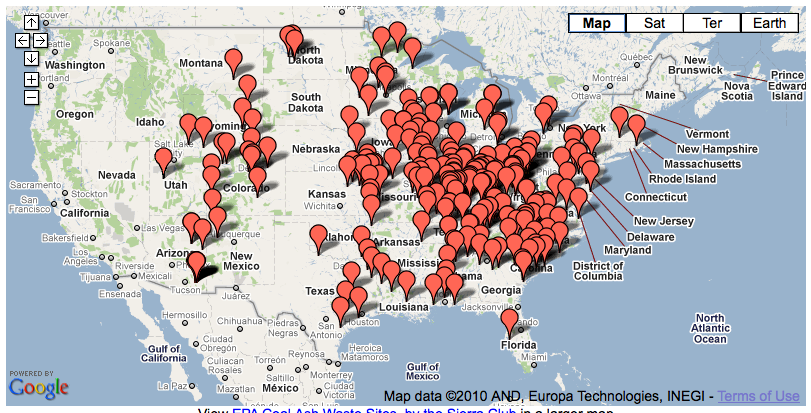
This map, via the Sierra Club, gives a great graphic understanding of how many of these disposal sites there are in the U.S. (see here as well for an excellent list of resources to learn more about this horrific problem).
So call it an act of patriotism, or just a variation on the subject matter of my usual ranting and raving, but I decided to participate and to tell the Environmental Protection Agency that as a citizen, I expect them to do what their name implies. Here is my testimony:
Testimony for the EPA Coal Ash Residuals Public Hearing
Louisville, KY Sept. 28, 2010
My name is Lucinda Marshall and I’ve lived in Louisville, KY for more than 20 years and I’m appalled that it wasn’t until after the Tennessee coal ash disaster that I became aware that we have toxic coal ash ponds right here in metropolitan Louisville.
According to the Sierra Club, in the state of Kentucky alone we have 44 ponds at 17 plants, 7 of which are rated as high hazards, and 5 as significant hazards. This is unacceptable.
After the incredible damage caused by the Tennessee pond breach, I am particularly horrified that these things are located in the middle of a large population center such as Louisville. If such a disaster happened here, the damage it would cause would be unimaginable and far worse than the Tennessee disaster.
Given that, I absolutely can’t understand how the EPA can consider anything but the most stringent guidelines for these facilities with the ultimate goal of making them illegal. It is beyond belief that these wastes are still considered exempt from such regulation.
There has been report after report documenting the highly negative impact that coal has on our environment as well as on human health. I am particularly concerned about the impact on pregnant women and children.
And all that talk about how coal is good for the economy? That sure hasn’t worked out so well in Kentucky which remains one of the poorest, least educated and least healthy states in the nation and no amount of building golf courses where amputated mountaintops used to stand will change that.
The people of Kentucky, the southeast and the entire nation deserve the right to a clean environment that is not being poisoned because of corporate malfeasance and greed and it is incumbent on the Environmental Protection Agency to do what its name implies and stringently regulate coal ash disposal.
Thank you.
———-
(Note: There is a three minute time limit on on testimony that is presented publicly, thus the brevity of my statement, much more can and should be said.)
Guess, what, no worries about that nasty Corexit dispersant stuff toxing out the seafood you eat. Never mind that the stuff has been banned in Europe, if the FDA says it is safe, well by golly, it must be safe, safer than dish soap even:
How cool is that--it kills the fish which then float right up to shore, no need to worry about whether you can catch it with your trusty fishing rod any more.
“The ingredients include propelyne glycol, a chemical permitted by FDA as a food additive and used in medicines, cosmetics and toothpaste; 2-butoxyethanol, which is found in cleaners, liquid soaps and cosmetics and quickly degrades in the environment; and a proprietary form of sulfonic acid salt, which is “moderately” toxic to freshwater fish and invertebrates but which the manufacturer says degrades quickly. In addition, Corexit contains volatile organic solvents that are made from crude oil and are not considered by the FDA to pose a public health concern because they do not accumulate significantly in the flesh of fish, according to Ireland.”
Want a side of fries with that? And just in case you don’t believe the FDA, here’s a video of a dude who works for Nalco, the company that makes Corexit demonstrating how it works. You can tell that it is perfectly safe cuz he’s wearing the industrial strength rubber gloves while he does the demonstration.
“The FDA is not monitoring fish and shellfish for the presence of Corexit in seafood because it is not considered a health risk, Ireland said.”
Well that is convenient, then we don’t have to worry for another 20 years that there might be health risks that don’t show up immediately because even if we all suddenly keel over and die, we won’t be able to blame it on the Corexit because no one bothered to study it. But I’m sure BP and the Feds were looking out for our best interests and just didn’t want to waste any money on silly ol’ monitoring.
And shame on the WaPo for just giving them a pass on this in their coverage.
While I”m delighted to see this piece in Truthout about the horrors of depleted uranium, it erroneously refers to,
“a previously undisclosed 1993 Defense Department document written by then-Brigadier Gen. Eric Shinseki, now the secretary for the Department of Veterans Affairs (VA), shows that the Pentagon was concerned about DU contamination and the agency had ordered medical testing on all personnel that were exposed to the toxic substance.”
“It is the military’s use of Depleted Uranium that should cause the most alarm. Not only is the evidence of irreparable harm becoming undeniable, it is also quite clear that the U.S. government has been aware of the lethality of these weapons for quite some time. Despite denials of health risks, a 1950 Army pamphlet states, “Although there is negligible danger from uranium and plutonium outside the body, it is possible for dangerous amounts of these elements to enter the body through the lungs, the digestive system, or breaks in the skin.” (14) An FAA Advisory Circular written in 1984 stated, “if particles are inhaled or ingested, they can be chemically toxic and cause a significant and long-lasting irradiation of internal tissue.” In 1990, U.S. Army Armaments, Munitions and Chemical Command (AMCCOM) reported that depleted uranium is a “low level alpha radiation emitter, which is linked to cancer when exposures are internal.” AMCCOM’s radiological task group also pointed out that the “long term effects of low doses [of DU] have been implicated in cancer, there is no dose so low that the probability of effect is zero.” The risk to our own military personnel was spelled out in a 1993 letter from the U.S. Army Surgeon General stating that, “When soldiers inhale or ingest DU dust, they incur a potential increase in cancer risk.” And in 1995, a U.S. Army U.S. Army Environmental Policy Institute report to Congress says that depleted uranium has the potential to generate “significant medical consequences”. (15)”
So enough already, we’ve known about the risks for decades, at least back to 1950, it is time to stop using these toxic chemicals. Not only do they harm our “enemies” in ways that violate the Geneva Convention, not to mention human decency, they also harm our own soldiers and citizenry and while the first part of that might be hard to understand, being our own collateral damage defies all logic.
Addenda: Truthout has changed their wording to, “little-known”, which is much better wording. I think an issue this does bring up is that it isn’t so much that this stuff is un-disclosed than that it is there,hiding in plain sight. It just requires some digging and some persistence by the media to make sure that it gets seen. In that, I am appreciative that Truthout is bringing it up and broadening the base of people who are aware of these atrocities.
A few years ago we spent a long weekend at a lovely hotel on the pristine St. Petersburg, FL shore. We walked along the beach, collected shells, ate seafood. Yesterday I got an email from them telling me they weren’t Pensacola and to come on down, the water’s fine. They even have their own no-spill-here -cam.
“Public officials have failed to sound an alarm about the public health threat because three federal agencies – DHHS, EPA, and OSHA – cannot find any unsafe levels of oil in air or water. Perhaps the federal air and water standards are not stringent enough to protect the public from oil pollution. Our federal laws are outdated and do not protect us from the toxic threat from oil – now widely recognized in the scientific and medical community.
BP is still in the dark ages on oil toxicity. BP officials stress that, by the time oil gets to shore, it is “weathered”
After wading in 'safe' water...
and missing the highly volatile compounds like the carcinogenic benzene, among others. BP fails to mention the threat from dispersed oil, ultrafine particles (PAHs), and chemical dispersants, which include industrial solvents and proprietary compounds, many hazardous to humans.
If oil was so nontoxic, then why are the spill response workers giving hazardous waste training? Our federal government should stop pretending that everything is okay. What isn’t safe for workers isn’t safe for the general public either.”
It bears remembering as well that the monitoring that is being done of air and water quality is not up to elementary school science standards in some regards. NRDC’s Gina Solomon points to sample results that, “don’t say where they were taken, and who was in the area.”
Questions have also been raised about testing labs with ties to BP and the veracity of assertions that dispersants are not in the air and increased arsenic levels. And then there is the matter of report after report of reporters being denied access to the effected areas. Bottom line–between deliberate misinformation, denial of access to information and an approach to scientific fact checking that is less sophisticated than a kid’s chemistry set, assurances of safety along the Gulf are suspect at best.
But that is not even the most dangerous part of the story. As I pointed out a few weeks ago, the oil disaster, first framed by BP, the government and media as a regrettable spill, quickly escalated into a war that needed to be fought. As Anne McClintock writes,
“Billy Nungesser, indefatigable President of the Plaquemines Parish, implores anyone who will listen: “We will fight this war….We will persevere to win this war.” For Ragin Cajun, Democratic strategist, James Carville: “This is literally a war… this is an invasion…We need to hear someone say ‘We’ll fight them on the beaches.’” Retired Gen. Russell Honore, who oversaw the Katrina debacle, insists: “We need to act like this is World War 111. Treat this like it’s an invasion…equal to what we decided about terrorists. We’ve got to find the oil and kill it.”…
…Visit the BP site (one of the more surreal Alice-Through-the-Looking-Glass internet experiences) and you will see the word “kill”–BP’s favored, faux-techno buzzword–appearing with ritualistic incantation. Kill the well, kill the leak, kill the oil, which morphs into “kill mud” (the mud that will kill the leak) and “kill lines” (the lines that follow the pipes to kill the leak)..
…So why are people calling the calamity a war and why does it matter that they do?
Calling the oil the ‘enemy’ helps us not to question who was culpable in the first place. Calling the response ‘a battle front’ helps us not ask who, other than the military, should be in charge. Calling the spill an ‘invasion’ helps us not to see that our global culture of militarization is what got us into the mess in the first place. Calling the spill a ‘war’ only fuels the pervasive militarization that produced the crisis in the first place. And calling the oil the enemy helps us not admit how much we, the consumers, having awakened the oil from its ancient slumber to fuel our gas-greedy lives, are the most complicit of all…
…All this war talk would be understandable, defensible even, were it not for a fatally circular, feedback loop. BP would not be in the Gulf drilling deeper than it knows how to drill were it not for its uniquely profitable relation with the US military war machine. The United States Department of Defense buys more oil than any other entity on the planet. The protection of overseas oil is now so unquestioned that even Defense Secretary Gates warned against the “creeping militarization” of U.S. foreign policy. And to fuel this militarization, the Pentagon uses 75% of the oil bought by the DOD for its jets, bombers, drones, tanks, and Humvees. And in order to keep buying this oil, the military has to keep protecting our regional oil interests, two thirds of which are now in conflict prone zones. US military bases in Iraq and Afghanistan use a staggering ninety million gallons a month. And to garrison this vast, global gas-station, the DOD keeps expanding, which means buying more oil.
From whom? In 2009, BP was the Pentagon’s largest contractor at $2.2 billion…
…Keeping this in mind, we would do well to remember that militarization is the number one cause of environmental destruction in the world, and that military production facilities, which are exempt from environmental restrictions, are the most ecologically devastated places on earth. We drill, we spill; nature pays the bill.”
GritTV’s Laura Flanders asks some important questions about the connection between the economy, which according to experts such as Paul Krugman and Robert Reich is in serious trouble, and the military:
“The US is currently shedding hundreds of thousands of jobs each month. It’s not just in the Ozarks that the recruiters are the only ones with jobs around. The economy shed 125,000 jobs in June. That’s about the number of troops we have left in Iraq…
…We’ve long heard about fighting people over there so we don’t have to do it here. Is the colder truth becoming that we’re sending people over there because we sure can’t employ ’em over here? And we’re scared to death of what unrest might come with a massive return of men and women who’ve served and endured — and who expect something better for their families than starvation wages, and no social services when they get back?”
I think there is a lot of truth to that as well as to the fact that a bad economy makes for fruitful military recruitment when kids can’t get jobs or afford college, why not join the military like that cool recruiter who hangs out at lunch in the cafeteria in that bad-ass uniform is pushing you to do. As McClintock points out, the military is busy defending the oil on which its existence depends. And for that it needs an endless supply of human cannon fodder.
And so we fight pointless wars without end rather than actually defending our citizens or literally, our shores. We allow the real enemy to tell us how to ‘clean’ up the resultant disaster and to control the information flow even while the oil flows unabated, because we are addicted to their product and our Congress has been bought off.
As for the beaches of St. Pete–are they safe? Perhaps. I hope so, but we simply cannot have enough confidence in what passes as data to say so, even if the damage is not visible. What is unquestionably dangerous however is the wholesale usurpation of government oversight by a lawless private corporation and the denial of freedom of the press in covering this story. As damaging as this disaster has already been to the ocean, shoreline and inhabitants of both, it will continue to be more so unless we insist on proper precautions, good science and full transparency. Above all, it is time to take a long overdue, very hard look at just what our military is supposedly defending and why and how, in the end, real security is defined.
As I was listening to Obama’s Oval Office oil ‘spill’ speech, I had a fantasy that he was going to tell us that he would immediately order the cessation of the use of dispersants because clearly they were making things even worse than just the oil and that going forward, the U.S. would do its bit to cut dependence on oil by immediately ceasing all military actions because BP is the Pentagon’s largest fuel supplier and it was time to set an example for the rest of the world by being good planetary citizens.
Unfortunately, not only did Obama not say this, it came off sounding like he was going to war with the oil, while all the while referring to it as a ‘spill’, rather than an act of corporate terrorism. Very metaphorically mixed thinking, that ended with an actually we got nothing reference to faith.
“Already, this oil spill is the worst environmental disaster America has ever faced. And unlike an earthquake or a hurricane, it’s not a single event that does its damage in a matter of minutes or days. The millions of gallons of oil that have spilled into the Gulf of Mexico are more like an epidemic, one that we will be fighting for months and even years.
But make no mistake: We will fight this spill with everything we’ve got for as long as it takes. We will make BP pay for the damage their company has caused. And we will do whatever’s necessary to help the Gulf Coast and its people recover from this tragedy.
Tonight I’d like to lay out for you what our battle plan is going forward: what we’re doing to clean up the oil, what we’re doing to help our neighbors in the Gulf, and what we’re doing to make sure that a catastrophe like this never happens again.
First, the cleanup. From the very beginning of this crisis, the federal government has been in charge of the largest environmental cleanup effort in our nation’s history — an effort led by Admiral Thad Allen, who has almost 40 years of experience responding to disasters.”
Can we just call bs on that last statement?
“We now have nearly 30,000 personnel who are working across four states to contain and clean up the oil. Thousands of ships and other vessels are responding in the Gulf. And I’ve authorized the deployment of over 17,000 National Guard members along the coast. These servicemen and women are ready to help stop the oil from coming ashore, they’re ready to help clean the beaches, train response workers, or even help with processing claims — and I urge the governors in the affected states to activate these troops as soon as possible.”
While I actually agree that in fact that is a good use of the National Guard, why on earth did it take this long to authorize their use? But as I said, the tenor of his speech was of the ‘this is war’ genre and frankly, I don’t think Mother Earth can take any more assaults. We need to absolutely quit talking about cleanup and recovery as if we can make this disappear. We can clean up some of it, salvage what we can, and work to make people’s lives whole again, but we can’t fix this disaster–significant parts of the Gulf are now dead and we have unleashed a toxic monster that will be with us for a long time if not forever, and no amount of National Guard troops is going to change that.
———-
Addenda: Robert Scheer eloquently addresses the inexcusable war lingo here:
“What’s with the president’s war analogy on the oil spill? It’s as if some alien force, “The Invasion of the Slippery Sludge,” suddenly attacked us. “Abroad, our brave men and women in uniform are taking the fight to al-Qaida,” President Barack Obama said Tuesday in his White House speech, “and tonight, I’ve returned from a trip to the Gulf Coast to speak with you about the battle we’re waging against an oil spill that is assaulting our shores and our citizens.”
What nonsense. The oil was minding its own business until some multinational corporations, enabled by a dysfunctional government regulatory regime, decided to wage war on the ecological balance of the oceans by employing technology that they were not prepared to control. Cleaning up the oil spill mess we made by raping the environment to satiate our consumer gluttony is not a glorious battle against evil but rather obligatory penance for the profound error of our ways.
You wound Mother Nature by punching a hole deep in her pristine ocean where you have no business going and when she bleeds uncontrollably you dare blame her for the assault? This from a president who shortly before this disaster had given the oil companies permission to pillage in the deep seas at will.”
Last week, in an article published by Truthout, I examined the potential for human reproductive harm as a result of the Gulf oil disaster. It was not until this week however that the EPA finally released information regarding what chemicals are in the dispersants, a crucial first step in definitively assessing harm. The manufacturer, Nalco, had claimed that some of the ingredients were trade secrets. But they were happy to explain in general terms on their website what was in the dispersants,
“Corexit contains six primary ingredients. Examples of everyday products with specific ingredients in common with COREXIT 9500 include:
• One ingredient is used as a wetting agent in dry gelatin, beverage mixtures, and fruit juice drinks.
• A second ingredient is used in a brand-name dry skin cream and also in a body shampoo.
• A third ingredient is found in a popular brand of baby bath liquid.
• A fourth ingredient is found extensively in cosmetics and is also used as a surface-active agent and emulsifier for agents used in food contact.
• A fifth ingredient is used by a major supplier of brand name household cleaning products for “soap scum” removal.
• A sixth ingredient is used in hand creams and lotions, odorless paints and stain blockers.”
Really? We drink this stuff and put it on our babies? Must be harmless, right? So why not just tell us the exact ingredients??
Finally however, the public and planetary right to know has triumphed over greed. Two different versions of Corexit have been used. The New York Times provides this description of the two products:
“Corexit 9527, used in lesser quantities during the earlier days of the spill response, is designated a chronic and acute health hazard by EPA. The 9527 formula contains 2-butoxyethanol, pinpointed as the cause of lingering health problems experienced by cleanup workers after the 1989 Exxon Valdez oil spill, and propylene glycol, a commonly used solvent.”
“Corexit 9500, described by Pajor as the “sole product” Nalco has manufactured for the Gulf since late April, contains propylene glycol and light petroleum distillates, a type of chemical refined from crude oil. Nalco had previously declined to identify the third hazardous substance in the 9500 formula, but EPA’s website reveals it to be dioctyl sodium sulfosuccinate, a detergent and common ingredient in laxatives.”
Memo to self: avoid laxatives at all costs. But seriously, what the heck are those chemicals and what can they do? Tom Philpott has written the most thorough description that I’ve seen thus far:
“We finally know the main two dispersants that BP and the U.S. government are using to treat the ongoing Gulf spill. Both, by their maker’s own admission, have the “potential to bioconcentrate,” and both have “moderate toxicity to early life stages of fish, crustaceans, and mollusks,” according to a study by Exxon, the company that originally developed them. Their use may be the least-bad course, given the importance of minimizing oil’s effect on coastal wetlands. But a little digging into the chemical makeup of these two substances, which are being dumped in vast quantities into the Gulf, reveals that they could potentially do far more harm than good, both to the Gulf and to humans who later eat from it…
…substances that bioconcentrate tend to move from water into fish, where they can do damage to the fish itself, as well as be passed on to predator fish – and on up the food chain, to human eaters…
…And just how toxic is this stuff? The data sheets for both products contain this shocker: “No toxicity studies have been conducted on this product” – meaning testing their safety for humans”…
…According to their data sheets, both 9500 and 9527 are composed of three potentially hazardous substances. They share two in common, organic sulfonic acid salt and propylene glycol. In addition to those two, Corexit 9500 contains something called “Distillates, petroleum, hydrotreated light,” while Corexit 9527 contains 2-Butoxyethanol…
…Petroleum distillates and 2-Butoxyethanol are both solvents; neither are substances you’d excitedly dump into a vibrant ecosytem. According to itsInternational Chemical Scorecard, 2-Butoxyethanol “may be absorbed” by the skin; causes “cough, dizziness, drowsiness, headache, nausea, and weakness” when inhaled; and “abdominal pain, diarrhea, nausea, and vomiting” when ingested. For petroleum distillates, the International Chemical Scorecard has similar indications about exposure for humans, and adds this unsettling line: “The substance is harmful to aquatic organisms.””
So we know that the dispersants contain toxic substances. It would seem that at the very least, since we’ve already dumped hundreds of thousands of gallons of them into the Gulf, that we–meaning presumably a governmental agency tasked with doing such things–should be rigorously monitoring their impact. Don’t hold your breath, or rather, it might be a good idea if you do. NRDC’s Gina Solomon reports that,
“New BP air testing results were posted.. from April 27 – May 26 for benzene, total hydrocarbons, and 2-Butoxyethanol. There’s still no information about other oil-related air toxic chemicals such as naphthalene or hydrogen sulfide, offshore.
The BP sampling plan focuses only on workers on the large ships, and appears to not include monitoring for the people on the approximately 1,500 small fishing boats helping to clean up the spill. These people are dismissed as of “Reduced Priority”on page 4 of the BP sampling plan.
Nearly 70% (275 out of 399) of offshore air samples had detectable levels of hydrocarbons and nearly 1 in 5 (73 out of 399) had levels greater than 10 parts per million (ppm), which is an EPA cutoff level for further investigation.
6 samples exceed 100 ppm which in a previous monitoring summary was labeled as the action limit. This label appears to have been removed in the most recent summary document. No information is given on where these samples, or the 4 found to be between 50 and 100 ppm, were taken.
20 (5%) samples had detectable levels of benzene with measurements up to 0.5 ppm. The National Institute of Occupational Safety and Health (NIOSH) Recommended Exposure Limit (REL) is 0.1 ppm.
20% (29 out of 146) samples had detectable levels of 2-Butoxyethanol with measurements up to 10 ppm. This range encompasses the NIOSH REL for occupational exposure to 2-Butoxyethanol of 5 ppm. The BP document cites the OSHA PEL for 2-Butoxyethanol of 50 ppm, which would not protect workers.”
In other words, it would appear that people working near these chemicals are being at least in some cases exposed to levels that are unacceptable. And those are the priority people, we don’t know about the reduced priority people. (Never mind all those chemicals, let’s just start by forbidding our data collectors from ever referring to anyone as a reduced priority person. And hello? Why is BP monitoring this, that has about as much integrity as putting an embezzler in charge of a bank fraud investigation.)
“The immediate worry is what are called volatile organic compounds, which include chemicals like benzene that can be released in a vapor phase from the oil that’s floating in the water,” Solomon said. “These chemicals can cause acute health effects such as headache, nausea, vomiting, cough, dizziness. The chemicals can also cause longer-term effects, including the potential for miscarriage or low birth weight in pregnant women and risk of cancer over the longer term.”
“So far,” Solomon added, “the levels of these chemicals have been fairly low along the shore lines, so the main concern is for the emergency response workers. But we’re worried that as the oil gets closer to shore the levels of the chemicals in the air will rise.”
So what does all of this mean? Good question. We know that several of the ingredients in these products are harmful. To what extent, we simply don’t know because:
A. They have not been adequately tested for toxicity prior to use.
B. No one has ever taken a wholesale toxic chemical dump in a large body of water on this grand a scale before.
C. There is a concern that by breaking the oil up, the dispersants are making the oil itself, also toxic, harder to clean up.
D. As Solomon notes, the data that we are getting via BP is problematic, making quantifying the damage all the more difficult.
I don’t want to re-hash all the points I made in the Truthout article, but suffice to say, this additional information only confirms my concerns. We know that aquatic life is dying, that wetlands are being grievously harmed, and that people are suffering from a variety of health symptoms. What we don’t know and won’t for quite some time is what the reproductive consequences may be. In the meantime, it is urgent that data be properly collected and made available and that every precaution be made to protect the most vulnerable among us, particularly pregnant women and children.
Addenda: Two additional points that add to the urgency of addressing this issue, via the San Francisco Chronicle:
“In a report written by Anita George-Ares and James R. Clark for Exxon Biomedical Sciences, Inc. titled “Acute Aquatic Toxicity of Three Corexit Products: An Overview” Corexit 9500 was found to be one of the most toxic dispersal agents ever developed.
According to the Clark and George-Ares report, Corexit mixed with the higher gulf coast water temperatures becomes even more toxic.”
And even more worrisome:
“It seems like damage brought by the oil gusher has spread way beyond the ocean, coastal areas and beaches. Collateral damage now appears to include agricultural damage way inland Mississippi.
A mysterious “disease” has caused widespread damage to plants from weeds to farmed organic and conventionally grown crops. There is very strong suspicion that ocean winds have blown Corexit aerosol plumes or droplets and that dispersants have caused the unexplained widespread damage or “disease”.
There is no other explanation for the crop damage. Everything points to something that has a widespread effect on plants and crops. While no one precisely knows, all the signs point to BP’s use of aerosolized Corexit brought inland by the ocean winds or rain.
Remember acid rain? Now it seems we could have toxic dispersant rain.”
In the Truthout article, I mentioned acid rain as a reason to be concerned that the toxicity of the oil and the dispersants could move inland. At the time, quite honestly I wanted the ramifications of that happening to remain a hypothetical nightmare. It would appear that this may be exactly what is happening, and the implications for our food and water supplies, our health and our lives are very, very bad.
As things get more and more surreal every moment on this planet, it becomes difficult to write in a way that
A last romp at the beach?
doesn’t send you the reader or me the writer into tears or over a cliff. While the oil continues to gush, there have been some truly bat-shit scary ideas of how to stop it, including the Dr. Strangelove nuke it solution. Nuking a hole in a gushing hole, radiating the gulf and who knows what else when the wind blows is helpful how?
One thing to be said for that idea, it makes the idea of putting the military, you know the one that is winning the wars in Afghanistan and Iraq, in to deal with it almost sound sane. I said almost. But not to worry,
“U.S. Defense Secretary Robert Gates is rejecting a more forceful role for the military in plugging the Gulf of Mexico oil leak.Gates says the deep-water disaster is beyond the military’s expertise.”
Osama Bin Laden is rolling on the floor laughing in his cave. We spend how much every year to protect ourselves against all manner of ‘terrorism’ and when we actually have a real something to be afraid about, the military’s response is ‘We got nothing’? Oh and in answer to how much we spend to not be able to defend ourselves against real threats, here is the growing count and amount,
“The US spent $661 billion on its military in 2009, a 75.8 percent increase from 2000. While current US military spending is still a carryover from the years of George W. Bush, President Barack Obama shows no signs of cutting spending. The Nobel Peace Prize winner excluded security-related expenditure from a planned three-year squeeze in discretionary expenditure. At a recent hearing before Congress, Secretary of Defense Robert Gates talked about efforts to trim the fat but the proposed Defense Department baseline budget for fiscal 2011 is $708 billion.”
But don’t look to divert any of those funds to cleaning up wetlands or providing employment assistance for those along the Gulf who now joint the ranks of the already beleaguered unemployed. After all, a strong defense is important.
And then there is the Goldman Sachs oh so timely sale of BP shares? No need to be suspicious of that with Tim Geithner at the helm.
And the recession remember the recession? Is it back? Might could be, hardly a surprise, ‘splains the mirage like quality of our supposed recovery.
And in the miscellaneous oh there’s a surprise category:
1. Meanwhile, we spent how much money fighting the less than epic swine flu pandemic to the benefit of big Pharma and why? Remember Rumsfeld’s connection with Tamiflu? Nuf said.
2. And radioactive fish? Has nothing to do with proximity to nuclear plants.
Meanwhile, Arizona is doing its damnedest to whitewash itself, Israel went into its bat shit bully mode and the DADT debate is promising to last longer than the healthcare debate. I won’t even bother with links for those, you know, and I can’t bear to even spend the time to remind you. Stay tuned, the bad news is there will be more bad news and worse yet, more bad lies. And you’ll never guess who is going to get stuck paying the tab.
 Early Saturday evening I decided to just ignore the fact that President Obama decided to start another war on a weekend after we’d just spent a week being totally traumatized by the disaster in Japan. I mean really? This couldn’t have waited until Monday? So I selfishly took two hours off to watch a cheesy movie without my laptop at my side. I know, you can see this coming– the second the credits are rolling I tune back in and bam! Now we have an oil slick too? I need to join a union, didn’t they bring us weekends?