What Now?

Remember that  careful list you think about making early in the year about how much you will spend on holiday shopping and then it all goes to hell in late December when you mostly just want to get done and go home…

With almost no debate

The U.S. Senate approved a $636 billion military spending bill on Saturday that funds the wars in Iraq and Afghanistan and also includes money to extend jobless aid and Medicare payment rates for two months.

By a vote of 88-10, the Senate approved the bill and sent it to President Barack Obama to sign into law. The House of Representatives passed the bill on Wednesday.

The bill covers Pentagon operations through September 30, 2010. But the $128 billion approved for ongoing wars probably will not be enough to cover Obama’s plans to send 30,000 more troops to Afghanistan

…lawmakers funded 10 more Boeing Co C-17 transport planes than the Pentagon had asked for, at a cost of $2.5 billion.Congress also kept alive over the Pentagon’s objections the troubled VH-71 presidential helicopter, made by Lockheed, and an alternate engine for the F-35 Joint Strike Fighter made by General Electric Co and Rolls Royce Group Plc.

Then there was the health care bill that we were told last summer would cost a trillion dollars over 10 years.  The cost of the current plan is unknown because the Senate has devolved into  a last minute Christmas shopper who has to buy a gift no matter what it costs, might find a bargain or have to pay full price but hey as long as you get  it before Christmas who cares.  And then  there is the Copenhagen “agreement“:

“Finally we sealed a deal,” U.N. Secretary-General Ban Ki-moon said. “The ‘Copenhagen Accord‘ may not be everything everyone had hoped for, but this decision…is an important beginning.”

But a decision at marathon 193-nation talks merely took note of the new accord, a non-binding deal for combating global warming led by the United States, China, India, Brazil and South Africa.

The 193 nations stopped far from a full endorsement of the plan, which sets a target of limiting global warming to a maximum 2 degree Celsius rise over pre-industrial times and holds out the prospect of $100 billion in annual aid from 2020 for developing nations.

The plan does not specify greenhouse gas cuts needed to achieve the 2 Celsius goal that is seen as a threshold for dangerous changes such as more floods, droughts, mudslides, sandstorms and rising seas.

If asked, I wonder how President Obama would characterize his leadership style, because I don’t know what you call it when the Congress spends the better part of a year crafting an expensive, deadly healthcare plan while barely blinking an eye about spending even more money on poorly defined wars  while completely trivializing the issue of climate change that ought to be a national emergency priority item.

Without a question we need to re-prioritize our thinking and change our framework, to wit, profit at the expense of human rights and environmental degradation should be considered a treasonous act.  We also need to play a little round of six degrees.

The U.S. military is arguably the world’s biggest polluter.  When we spend money on the military we need to take into account that aside from funneling that money from education, health care and other vital services that make us more secure, we are also contributing to the further environmental degradation of the planet.  And courtesy of IrishAntiWar.org, here are some other connections between military spending and the environment:

  • Projected total US spending on the Iraq war could cover all of the global investments in renewable power generation that are needed between now and 2030 in order to halt current warming trends.
  • CO2 released by the war to date equals the emissions from putting 25 million more cars on the road for one year.
  • If the war was ranked as a country in terms of annual emissions, it would emit more CO2 each year than 139 of the world’s nations do.
  • The $600 billion that the US Congress has allocated for military operations in Iraq to date could have built over 9000 wind farms (at 50 MW capacity each), with the overall capacity to meet a quarter of the US’s current electricity demand and cut 1/6 of the country’s total CO2 emissions.
  • In 2006, the US spent more on the war in Iraq than the whole world spent on investment in renewable energy.
  • US president Obama has committed to spending $150 billion over 10 years to advance the next generation of green energy technology and infrastructure. The US spends that much on the war in Iraq in just 10 months.

I’ve also been thinking about the odd juxtaposition of the use of abortion rights as a tool of white, conservative American men to jettison meaningful health care in this country and the increasingly louder drumbeat, mostly by white, liberal American men to tie the benefits of family planning to the use of population control for the sake of the planet. Really?  Using the latter line of reasoning we should also cut maternal health care funds such as they are because hell, half a million (almost exclusively non-white) women die of maternal mortality every year and if we can up that number, that means less babies and mothers and that is good for the planet.  It is no accident that the colonization and control of women’s lives is being ratcheted up at the same time we trash the planet.  And we need to make that connection.

Derrick Jensen has an eloquent vision of the first step of what it would take to re-frame the discussion of how we are going to walk in this world, and I’ll leave you with that:

A lot of the indigenous people with whom I’ve worked have said to me that the first and most important thing any of us needs to do is decolonize our hearts and minds. Decolonization is the process of breaking your identity with and loyalty to this culture-industrial capitalism specifically, and more broadly civilization-and remembering your identification with and loyalty to the real physical world, including the land where you live. It means re-examining premises and stories this culture handed down to you. It means seeing the harm this culture does to other cultures, and to the planet. It means recognizing that we are living on stolen land. It means recognizing that the luxuries of this way of life do not come free, but rather are paid for by other humans, by nonhumans, by the whole world. It means recognizing that we do not live in a functioning democracy, but rather in a corporate plutocracy, a government by, for, and of corporations. Decolonization means recognizing that neither technological progress nor increased GNP is good for the planet. It means recognizing that this culture is not good for the planet. Decolonization means internalizing the implications of the fact that this culture is killing the planet. It means determining that we will stop this culture from doing that. It means determining that we will not fail.

Gift Warped

No that isn’t a typo in the title to this piece.  I love giving gifts, but what I am seriously not fond of is giving gifts because it is expected, a pastime that we  pursue with relentless obsession during the month of December.

As Genevieve Vaughan writes in For-Giving:  A Feminist Criticism of Exchange,

We have made giftgiving,  which is the source of life and joy, a slave to the artificial masculated ego and its  expressions at the economic, political, and ideological levels. This drains the gifts of  humanity into the coffers of the few, whose priapic excesses are kept from the needs and  transformed into phallic armaments, deadly ‘marks,’ by which one group can demonstrate  its ‘superiority’ over another,  which is forced to give way. (p. 118)

The connection between standing in line in the pre-dawn hours outside of Walmart on the day after Thanksgiving and the birth of Jesus is quite clearly non-existent, although the connection with the GNP is quite strong.  The degree to which the reason for the season has been lost in the traffic jam at the mall was illustrated quite nicely in the local newspaper where I was visiting over the Thanksgiving weekend which ran two stories side by side at the top of the first section, the first explaining how “Black Friday” is an important barometer of the economy and right next to it a story about cuts in state social services.

There are many good reasons to give, perhaps the best being to satisfy a need.  My father used to tell a story of giving his very nice winter coat to a perfect stranger in need during the Depression.  His Mother was not too thrilled by that, but what he did was gifting in its finest form.

On Facebook, JP Morgan Chase has set up the Chase Community Giving Program that allows Facebook users to vote on how they will give away $5 million to various charities.  Which sounds like a good thing, but let’s face it, $5 million is a pittance for the huge banking company that is heavily involved in financing for such detrimental things as mountaintop removal and has engaged in lending practices with credit cards and mortgages that have left a lot to be desired for its customers and the communities in which it lends and has involved a great deal more than $5 million.  So while they exchange their big bad corporation mantle for the generous corporate citizen mantle with programs such as these, it is hardly the same as the altruistic gift my father made as a  youngster.

Cause branding is a popular concept for many companies.  Breast cancer has become highly profitable for any company that can figure out how to take whatever it is that they manufacture and make a pepto pink version of it from which they will donate some exceedingly small percentage to finding a cure while they still profit handsomely from the sale of whatever doodad they are hawking.  But hey, they look good, you got a beautiful new pink thingy and can feel virtuous about buying it because it is for a good cause.  Of course, if you’d written a check for the same amount to the charity that  benefits from your purchase, it would be much more useful, but you wouldn’t have anything to show for your virtuousness and these days, that is a hard sell.  We want something in exchange for what  we give.  Companies want recognition, not to mention profit, for their  community support.  Bottom line is we are much more likely to give if we get something in return.  Even charities feel the need to give you something for your generosity–think raffles, public television premiums, etc.

———-

Nine years ago when I suffered a serious illness that put me out of commission for several months, I learned that while giving  might  be easy, receiving was a much, much harder thing to do.  I was a single mom with 2 young children and I was flat on my back in a hospital bed, a position from which you can definitely not drive carpool.  All of a sudden things that I somehow managed to juggle on my own required the help of others and much as I’ve never been good at asking for that help, it was clear I had no choice.  But what I found out over and over again was that all I needed to do was  to say what was needed and there would be someone who would help.  They didn’t expect anything in return, that  was never the point, much as a mother tends to a baby’s needs simply because there is a need, not in exchange for something given in return.  They gave their time and help according to what Vaughan calls the gift paradigm which she explains this way:

The gift paradigm emphasizes the importance of giving to satisfy needs. It is need-oriented rather than profit-oriented. Free giftgiving to needs–what in mothering we  would call nurturing or caring work–is often not counted and may remain invisible in our  society or seem uninformative because it is qualitatively rather than quantitatively based.  However, giving to needs creates bonds between givers and receivers. Recognizing  someone’s need, and acting to satisfy it, convinces the giver of the existence of the other, while receiving something from someone else that satisfies a need proves the existence of  the other to the receiver. (p.30)

Quite a far cry from the dominant form of gifting in our society today, which Vaughan calls exchange.  While I’ve used the commercialized giving that epitomizes December as a jumping off point, the notion of exchange and gifting go well beyond that to describe economic systems as a whole:

Opposed to giftgiving is exchange, which is giving in order to receive. Here calculation  and measurement are necessary, and an equation must be established between the  products.
In exchange there is a logical movement which is ego-oriented rather than other-oriented.  The giver uses the satisfaction of the other’s need as a means to the satisfaction of her  own need. Ironically, what we call ‘economics’ is based on exchange, while giftgiving is  relegated to the home–though the word ‘economics’ itself originally meant ‘care of the  household.’ In capitalism, the exchange paradigm reigns unquestioned and is the mainstay  of patriarchal reality. (pp.30-31)

As the  newspaper stories I mentioned above sadly illustrate, our current mode of gifting is indeed a measure of the economy, and it is precisely the amount we spend and charge that indicates the non-viability of the system when at the same time services for those in need are being cut. Vaughan’s work in demonstrating that there are viable and far healthier alternatives to our current economic system has, to say the least, been marginalized and is familiar for the most part only in limited circles of feminist critique.  However, as we face multiple crises–the economy, healthcare, climate change, war, it would be extremely useful to go outside the usual box in all its fancy wrapping to utilize her  wisdom in understanding and healing our world systems.

The First Church Of The Sidewalk

We’re having the wrong conversation, or perhaps more accurately, we’re having a lot of wrong conversations.

This past weekend, I joined a small group of people from across our community who felt moved to stand up against the escalation of the war in Afghanistan.  We chose to stand in a place where we have visited before in the cold December air–on the sidewalk next to the main road leading  to the biggest shopping malls in town because we knew people would have plenty of time to read our signs as they were stuck in traffic.  The traffic was lighter than it has been in past and several stores in the strip mall behind us have been shuttered in the last year.  No  doubt people heading into the malls will  be spending less this year, considering each purchase a bit more carefully.

A few people yelled angry things at us, most just stared, a few  honked and waved in support.  But they all kept driving.  Into the mall, with less money but refusing to see  the connection between the money we spend in Afghanistan, for what noble  cause (as Cindy Sheehan eloquently puts it) I have no idea.  In explaining the reasons for the escalation, Obama opened with references to 911, claimed that terrorists trained overseas had been found in America (although on  the Colbert Report a few nights later, Homeland Security Secretary Janet Napalitano was hard-pressed to offer any evidence of that, and the mainstream media sure isn’t pressing the point).  Obama’s  speech offered no change, in fact it could have  just as easily been  delivered during the Bush presidency. Telling us we must risk more lives to fight the elusive enemy called terror. And meanwhile,  Americans rack up credit card debt at the mall just in time for Wall Street to hand out its obscene bonuses.

Change?  Not hardly, just a propping up of the system so that it can keep feeding on itself.  Congress meanwhile bound and determined to pass a healthcare bill regardless of merits cheerfully sold out women’s reproductive rights in the eleventh hour for 3 votes and whatever the final form of what is likely to be a very sorry piece of legislation looks like, the compromises made in the name of health industry ‘support’ will no doubt come at the cost of lives, probably many more lives than have been lost to ‘terrorism’. Still, people keep driving to the mall.

But perhaps nowhere is the discussion more nonsensical than when it comes to the environment.  The whole notion of Cap and Trade is insane (and for a wonderful, easy explanation that even a grade-schooler (although apprarently not members of Congress)  would understand of why, go here).  Here in the southeastern U.S. our mountains have been sacrificed for coal, the tops summarily cut off and the debris  dumped in our streams as if we have the right to do  such a thing without regard for the true cost to people and the environment.

As Bill McKibben points out, this wrong conversation about the environment, unlike the wrong  conversations about the economy and health care, has the potential to be an end game, to wit physics does not know to respond to politics, “It’s like nothing we’ve ever faced before — and we’re facing it as if it’s just like everything else. That’s the problem.”

And still, people keep driving to the mall.  Back in 2002, as the war in Afghanistan was ramping up, we had a  sign in our yard that said, simply, “Peace”.  Some of my neighbors felt moved to respond by literally circling our front door with “We Stand With President Bush” signs. It was a terrifying sight. When the Christmas season rolled around again later that year, one of my sons wondered what would happen if we put a sign up that said “Peace on earth, Goodwill to all.”   In the years since, I have stood my peace several times alongside the malls as we did last weekend.  And in the last few weeks, I have stood up for health care, and for the environment.  And I’ll keep standing up. I think of it as attending the First Church of the Sidewalk, surely a far holier experience than a day at the mall.

The one thing I know for sure–we need to quit the annual mall trek, get out of our cars, put down the plastic shopping bags and say enough of the damaging and downright deadly conversations.  Health care is a human right, war does not create peace and most assuredly begets terrorism.  The wealth of corporations cannot come at the expense of the welfare of people and we can not trade our way to capping carbon or fuel our world by destroying mountains.

Stand up.  Speak out.  It is  time to insist upon speaking truth to power.

Scenes From A Zipless Recovery

Dear Main Street Residents,

The recession is ending, no more worries, sorry for the inconvenience.

Love,

Your BFFs  on Wall Street

As the national economy starts its slow recovery, 11 states and the District of Columbia are showing signs of emerging from the recession, according to a new report. (from Moodys Economy.com via Stateline)

Moody’s also estimated that the national recession ended in August, although the National Bureau of Economic Research, a private research firm that calculates the official dates of recessions, has yet to declare the end of the current downturn.

But let’s just bear in mind where that rose colored pronouncement came from– according to a report from McClatchy,

The Securities and Exchange Commission issued a blistering report on how profit motives had undermined the integrity of ratings at Moody’s and its main competitors, Fitch Ratings and Standard & Poor’s, in July 2008, but the full extent of Moody’s internal strife never has been publicly revealed.

Translation:  I’ve got some swamp land in Florida for sale.  Well actually I don’t but can you blame me from trying to sell it to you anyhow.  If you want a more  honest take on the view from the top of the economic pecking order, this refreshingly honest commentary from a Goldman Sachs executive is probably more to the point:

“The injunction of Jesus to love others as ourselves is an endorsement of self-interest,” Goldman’s Griffiths said Oct. 20, his voice echoing around the gold-mosaic walls of St. Paul’s Cathedral, whose 365-feet-high dome towers over the City, London’s financial district. “We have to tolerate the inequality as a way to achieving greater prosperity and opportunity for all.” (Bloomberg)

Meanwhile, down the block on Main Street,  recovery NOT is still a happening event:

The official jobless rate — 10.2 percent in October

one out of every six workers — 17.5 percent — were unemployed or underemployed in October. (New York Times)

For black teens nationwide, the rate was 40.8 percent in September. (Chicago Tribune)

40.8%…just roll that number around in your brain for awhile. Then consider this:

U.S. companies increased their output in the third quarter even as they slashed working hours, driving productivity up at a 9.5% annual rate in the quarter, the Labor Department estimated Thursday. …

Productivity is output divided by hours worked. Output rose 4% annualized, while hours worked plunged 5%. Real hourly compensation increased at a 0.2% annual rate. (Market Watch via Daily Kos)

If you look in your Berlitz for Wall Street-ese, that translates to, ‘we worked harder for less hours to make more stuff which we can afford less because we
earned less or worse yet, lost our job. And here’s a little conjugation of the screw you verb translation above,

Credit card companies are rushing to increase interest rates to historic highs of more than 30 percent, cut credit limits, and add new fees, even for customers who pay their bills on time. (Boston.com)

And then there is the pesky matter of health care and the ‘reform’ that is supposed to  cure it:

According to research by the John Hopkins Children’s Center, an analysis of 23 million hospital records from 37 states shows that a lack of health insurance likely played a role in the deaths of nearly 17,000 U.S. children over a 17-year period. (Denver Post)

One wonders if “children not covered” is a line item in annual reports by insurance companies which just had a VERY profitable quarter:

Managed care company Cigna Corp.’s third-quarter profit soared 92 percent, as improving equity markets spurred a big turnaround in a discontinued business that hurt the insurer last year.

Don’t know about you, but I sure the hell can’t sleep at night with that.  And lastly, give a big cheer for the ever so Gross Domestic Product that rose a “better than expected” 3.5% in the third quarter.  And here is one reason:

Billed as a way for the government to put more fuel-efficient vehicles on highways, the popular $3 billion Cash for Clunkers program mostly involved swaps of old Ford or Chevrolet pickups for new ones that got only marginally better gas mileage, according to an analysis of new federal data.
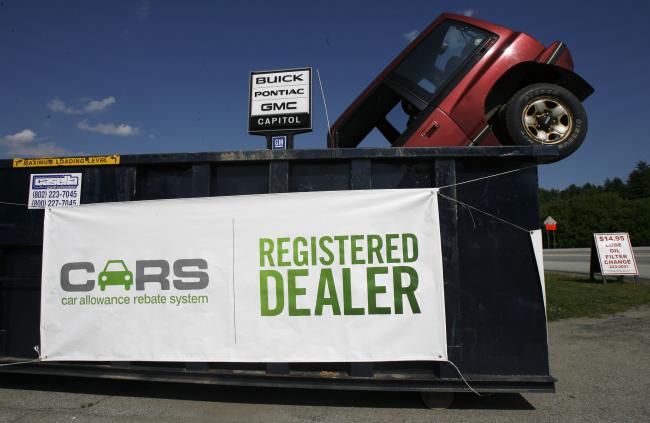
The single most common swap — which occurred more than 8,200 times — involved Ford F150 pickup owners who took advantage of a government rebate to trade their old trucks for new Ford F150s. They were 17 times more likely to buy a new F150 than, say, a Toyota Prius. The fuel economy for the new trucks ranged from 15 mpg to 17 mpg based on engine size and other factors, an improvement of just 1 mpg to 3 mpg over the clunkers.

The overall mileage increases over the clunker fleet represent a decline of 1.87 million tons of carbon dioxide per year, based on families driving an average of 12,000 miles, a yearly savings equivalent to the amount of carbon dioxide spewed in the U.S. in just 2.5 hours. (AP)

(Note–To get a further idea of just how absurd this program was, during the Cash for Clunkers program, I traded in my 10 year old van that was beginning to have significant problems  for a car that gets much better milage.  However since my van officially got  19 mph, I didn’t qualify for the program, even though my new car is far more efficient than some of the trucks and SUV’s that qualified for the rebate.  And while it gave a huge short-term boost to auto sales, it is doubtful that will have a long-term impact and the more important question is why boosting the auto industry without a significant change in transportation policy is appropriate in the first place.  Yes jobs are at stake, but this kind of short-term thinking is not going to save those jobs in the long run.)

Dave Lindorff has a more detailed explanation,

Most of that rise was the result of government subsidies to car-buyers and first-time house buyers. It was a one-shot stimulus that pushed forward spending, but it was no indication of a recovering economy, just a spasm of spending using taxpayer money. Furthermore, an excellent article in Businessweek by Michael Mandel noted that fully one-percent of that GDP gain was the result of a failure by government economists to account for a collapse in corporate spending on research and development and on training and retaining intellectual assets (a complicated way of saying that engineers, scientists and technology workers were being laid off at a higher rate than other workers, and much R&D work was being shipped overseas for good), So really the “growth” of GDP in the third Quarter should have been at a 2.5% rate, and even that was largely government pump priming, not recovered economic activity.

So what to take away here?  First of all, let’s quit using the DOW as a measure of how things are.  As Lindorff points out apropos of the oft repeated ‘wisdom’ that employment is a lagging indicator,

High and pro-longed unemployment leads to reduced demand for goods and services, and to a psychology of fear and consumer withdrawal. Once people feel that they aren’t going to find a new job soon, and once those who still have jobs feel that their employment is not secure, they no longer buy things except what they absolutely need. And in an economy where fully 72% of economic activity is consumer spending, that is no longer a “lagging indicator.” High, prolonged unemployment becomes a causal factor in the economic downturn.

In other words, sooner or later (and I’m betting on sooner), there is  going to be major blowback on Wall Street.

In our current  economic system, the official barometer of whether we are economically healthy or not is based primarily on the health of corporate citizens, not human ones.  Don’t have insurance, a job or a house? No worries, the market is up.  Which really should give us pause to think that maybe, possibly, we are measuring the wrong stuff.

As all of the above should certainly serve to illustrate, the current discourse on the economy is delusional.  If we are  truly to ‘recover’ in a meaningful way, we will need to re-define what we consider as economic well-being. Imagine how our policies might be different if, as Riane Eisler suggests, we measured the value of caring.   Or if we gave to meet needs instead of assuming the necessity of an exchange of goods as Genevieve Vaughan suggests.

And while I am not going to address it in depth here, any sustainable economic policy must also take into account and be responsive to the issues of climate change and global warming.  We cannot continue to degrade the planet at will and we need to take immediate steps to address the changes that are already happening.

Until we make those paradigm shifts in the way we think about the economy, the rumors of its recovery should be considered as the poppycock that they are.

———-

Postscript–Lest there is any doubt–the title of this post traces it’s origins to Erica Jong’s Fear of Flying,

The zipless fuck is absolutely pure. It is free of ulterior motives. There is no power game . The man is not “taking” and the woman is not “giving.” No one is attempting to cuckold a husband or humiliate a wife. No one is trying to prove anything or get anything out of anyone. The zipless fuck is the purest thing there is. And it is rarer than the unicorn. And I have never had one.

–Erica Jong, Fear of Flying (1973)

Pyromaniacal

They burned witches didn’t they?:

The religious right has long railed against Halloween, condemning its pagan roots and claiming it promotes witchcraft and the occult. This year some groups are embracing the day as a time to reach kids with a pro-life and Christian message, while others use the day to burn “wicked” books and CDs.

A burning oil rig in the Timor Sea has spilled an estimated 400 barrels of oil a day since Aug. 21:

Forest fires:

Self Immolation in Afghanistan:

In the first seven months of this year, medical staff at the Herat’s burns unit – the only one of its kind in the entire country – said they have seen 51 cases of female self-immolation. Only 13 have survived.

Leaves

The leaves in my neighborhood are not extraordinary leaves.

They are as ordinary as the houses that line the streets.

But yet, each spring they miraculously emerge from the frost laden branches

peeking out demurely from the pink, fragrant blossoms.

All summer they hold forth, green, shady respite.

leaves1

And then in fall, one last riotous hurrah,  golden, red, orange before

The wind blows and skeletal trees remain to begin the long wait for spring.

I take it back, they are extraordinary.

leaves3

The Real Failure And What We Choose To Do About It

I went to see Where The Wild Things Are over the weekend, highly recommended although the beginning of the film ironically adds scenes that the film’s producers apparently imagined Sendak must have been thinking were the catalyst for this flight of fancy instead of Sendak’s quite plausible story line because it could not possibly be a commercial success I suppose unless you add some big bad mean teenage sister and her evil friends and a single struggling Mom who just needs affection herself.  Which unfortunately takes an elegant tale and makes it both problematic and unsuitable for younger children, for whom the book was written in the first place.

Okay, so maybe that is a rather qualified recommendation. Even so, I still greatly enjoyed the film.  But after coming home and re-reading the book, I started thinking about the point that regardless of where our flights of fancy lead us, sooner or later we need to come back to reality.  Which of late here on Planet Earth pretty much sucks.

The following morning as I was reading through the Sunday newspaper, I realized that the pile  of newsprint that was devoted to trying to sell me something I probably don’t need was far larger than the part devoted to informing me of the publisher’s take on what is so.  As an example, there were any number of ads hawking beverages in plastic bottles, but nowhere a reference to a recent report that,

Drinking water from plastic bottles made with the toxic chemical bisphenol A (BPA) increases urinary levels of the chemical by nearly 70 percent, according to a study conducted by researchers from Harvard University and the Centers for Disease Control and Prevention.

BPA, an industrial chemical that makes plastics hard and transparent, is widely used in plastic drinking bottles, infant bottles and other consumer products, and also in resins that line cans of food and infant formula. The chemical has been shown to disrupt the hormonal system, potentially leading to reproductive defects as well as brain damage, cardiovascular disease, cancer, obesity and diabetes.

Nor among all the glossy pictures do we see this:

On a daily basis, we are bombarded with a veritable avalanche of data that skewers our perceptions of what is real and what is important.  Not only that, but the historic context in which we process this bombardment is skewered as well, something that is made elegantly clear in the reading of From Eve to Dawn, Marilyn French’s history of women, or Riane Eisler’s The Chalice and The Blade, or other documentations of women’s lives and history that has been marginalized in the telling of our stories over the years (and ditto that point regarding the history of anything that isn’t pale and male).  As Corinne Kumar makes clear in this elegant speech, to truly attain social justice, we need to understand the roots and depth of the human condition, and that has been rather literally bleached out of history.

Which brings me to this–While the U.S. is operating, or more to the point not, on the assumption that our national decision-making must be  predicated on  the theory that mega banks and insurance companies are too big to fail, that corporate welfare must be preserved even at the cost of human welfare becoming a toxic asset, Richard Power points to the real show-stopping questions of whether the climate and human race are too big to fail, saying quite pointedly that if we don’t get a grip on climate change,

Goldman-Sachs and its ilk won’t be our biggest problem, or even among our top ten problems.

If the planetary climate is allowed to fail we will be circling back to

No longer too big to fail...Summer ice in the arctic will likely be gone in 20 years.
No longer too big to fail...Summer ice in the arctic will likely be gone in 20 years. But consider the amount of news coverage this story has gotten compared to the boy who didn't go up in the balloon.

the beginning of Kubrick’s 2001: A Space Odyssey, i.e., just a bunch of armed apes. Indeed, it is not just the future that we are in danger of losing but also the past.

As for the human race,

After all, it’s us, it’s all we’ve got.

But as Power eloquently documents, that point seems to be completely forgotten when it comes to things like our policies on issues such as Darfur or empowering women. Here in the U.S. we have been having an obsessively myopic national angst attack regarding the financial and health industries and our national ‘security’ at the expense of almost everything else–the environment, education, etc.

If indeed we continue to insist on measuring success by corporate wealth and how much stuff we make and buy, Goldman Sachs will continue to thrive.  For awhile.  But in the end, human beings and the climate will, inevitably, fail.

Does it have to be that way?  Honestly, I no longer feel any certainty that we can stop it from happening, we may well be beyond the tipping point.   But one thing is for damned sure, we don’t have to continue to contribute to our own demise.  There are many efforts being made to change our values paradigm to reflect the world that is really so. One very exciting new initiative is The Real Wealth of America Public Policy Project, based on Riane Eisler’s, “The Real Wealth of Nations” which,

is designed to advance the real wealth of our nation: the health, well-being, and full development of our nation’s women,  men, and children. A major aim of the project is to change the present economic  perspective to one that not only recognizes the enormous “back-end” financial costs of  failing to invest in people, but also recognizes the direct economic benefits of investing in
human capacity building.

As Eisler states: “Rather than trying to just patch up a system that is not sustainable, let’s use our economic crisis to move to an economic system that really meets human needs. As Einstein said, we can’t solve problems with the same thinking that created them. In our time of rapidly changing technological and social conditions, we must go deeper, to matters that conventional economic analyses and theories have ignored. We need a caring economics that no longer devalues the most important work: the work of caring for people, starting in early childhood, and the work of caring for our Mother Earth.”

The indicators for the currently used Gross National Product were developed and adopted  during the depths of the Great Depression. They were only meant by their authors to be a beginning for measurements, not the be all and end all.

We urgently need new economic indicators. The RWA public policy project is a strategic step toward achieving this goal.

The governing values for measuring and promoting the Real Wealth of Nations are:

  • Recognizing that the contributions of people are the real wealth of a nation– and hence the need to invest in human capacity development, starting in early childhood.
  • Recognizing that, especially for the post-industrial knowledge-information economy, our most important capital is high quality human capital.
  • Recognizing the need to give greater visibility and value to the work of caregiving in both the market and non?market economies.
  • Recognizing the value of investing in our human infrastructure for our world’s families, communities, equality, democracy, and economic success.

It is precisely this kind of thinking that is absolutely critical if we are to make the paradigm shift necessary to avoid presiding over the biggest failure of all, our own and that of Mother Earth.  I have a recording of Phil Och’s song “I Ain’t Marching Anymore” where he introduces the song as a “turning away song”.  Turning away is a very powerful statement and we  need to do a lot more turning away, from greed, from exploitation, from violence and hate.

We need to say no more, but we need to go beyond that–we need a change of direction such as Eisler is suggesting.  We need to do this on a personal level and on a societal level.  On October 24th, there will be a Global Day of Climate Action with events all over the world.  Find out what is going on where you live and make plans to be there, support The Real Wealth of America Public Policy Project, find  and support other projects that are path-changers. As Alice Walker so beautifully observes, we are the ones that we have been waiting for.

The Economy Of Empire Fail

The unaffordable cost of our reality.  I’ll leave it to you to add it up:

Too small to save:

A year after Washington rescued the banks considered too big to fail, the ones deemed too small to save are approaching a grim milestone: the 100th bank failure of 2009.

Burdened by worsening commercial real estate loans, many small banks’ troubles are just beginning. Many analysts say that the now-toxic loans could sink hundreds of small lenders over the next few years and place a significant drag on the economy.

Already, the bank failures are placing enormous strain on the F.D.I.C. and its fund, which keeps depositors whole. Flush with more than $50 billion only two years ago, the fund recently fell into the red.

So our federally insured deposits are insured with what, exactly?

One ringy dingy, two ringy dingy… speed dial tells all:

Geithner’s calendars, obtained by The Associated Press under the Freedom of Information Act, offer a behind-the-scenes glimpse at the extraordinary influence of three companies. More than any other company or any of their rival banks, Goldman, Citi and JPMorgan can get Geithner on the phone several times a day if necessary, giving them an unmatched opportunity to influence policy.

You’re gonna be asked, but don’t tell:

Neil Barofsky, the independent watchdog of the TARP program, recently said that while the Wall Street bailout did avert full-scale financial collapse, it plainly failed in its principal stated goal of increasing lending (because banks used the money to buy other institutions, create capital cushions, pay out bonsues, etc.).  He detailed how the Treasury Department actually tried (mostly unsuccessfully) to coach the banks into refusing to provide Barofsky with information about how they used the TARP money they received. Worse, he said that the U.S. economy is more dependent than ever on these same “too-big-to-fail” financial institutions, which have grown in size, and the U.S. economy is thus more vulnerable than it was even a year ago to an actual collapse.

Contributing to rape:

The thirty GOP Senators who voted against the Franken amendment, which protects women who were raped or sexually abused while working for private defense contractors, received generous contributions from those same private contractors.

Suck on this–Insurance company denies coverage to “obese” breastfeeding baby:

Alex Lange is a chubby, dimpled, healthy and happy 4-month-old.

But in the cold, calculating numbered charts of insurance companies, he is fat. That’s why he is being turned down for health insurance.

By the numbers, Alex is in the 99th percentile for height and weight for babies his age. Insurers don’t take babies above the 95th percentile, no matter how healthy they are otherwise.

“I could understand if we could control what he’s eating. But he’s 4 months old. He’s breast-feeding. We can’t put him on the Atkins diet or on a treadmill,” joked his frustrated father.

While the media was busy quoting old white guys, the woman we should have listened to because she got it exactly right:

Hey, Wanna Go To The Movies, Eat Popcorn And Then Commit Some Civil Disobedience?

Going to the movies just isn’t what it used to be.  In the olden days, you bought a ticket, plunked yourself into a seat, ate the popcorn and escaped from reality for a couple of hours.  No more.  It truly is a sign of the times that within the space of a week, two different movies opened that are not only hugely entertaining, but also offer biting analysis of our current economic crisis, globalization and climate change and implore viewers to not only watch but to also take action.

If Econ 101 made no sense to you and  guys like Greenspan and Geithner sound like they are speaking in tongues, go see Michael Moore’s Capitalism:  A Love Story, all will be illuminated. The movie is funny and informative, but much more importantly, Moore intends it as a call to action,

As far as I’m concerned, Tea Bag Nation ends today — at noon to be precise. For that’s when I set loose, on a thousand screens across this great land, a movie I’ve made that’s so relentless, so dangerous, so damning in its humor, that it will — I can only hope — do what no movie has done before: Take them down, take them all down, once and for all.

On his website he has a “Do Something” page with links to organizations working on such issues as health care reform, the foreclosure crisis, subprime lending and information about the much and erroneously maligned ACORN.

While Moore leaves the choice of action up to you, the Yes Men, Andy Bichlbaum and Mike Bonanno, ask for something that I don’t think has ever  been asked in a major movie rollout–they are asking viewers to hit the streets and maybe even participate in a global civil disobedience action. Really. The Yes Men Fix The World, for lack of a better term, vivisects globalization and corporate greed and exposes it for what it is, and somehow manages to deliver its message despite the fact that the audience is laughing so hard they are gasping for air.

And then as the lights go on, they ask you to join them in protesting the truths they’ve just exposed.  During the opening nights, thus far, the audience has marched out of the theater and gone to  Whole Foods, JP Morgan Chase and an ICE detention center along with megaphones, musical instruments and Survival Balls.

Prior to the movie opening they also used the Survival Balls in a protest at the U.N. where Bichlbaum was arrested.  One thing learned–apparently it is quite difficult to handcuff someone in a Survival Ball.

Which leads us to what the Yes Men are really leading us to–civil disobedience:

Our film is a small part of a movement to help make that happen. Another part is BeyondTalk.net – a website we recently launched in collaboration with a dozen direct-action activists. The idea is to get 10,000 folks to sign the “Climate Pledge of Resistance” and risk arrest to demand sane climate-change policy. On November 30, the tenth anniversary of the Seattle protests, and a week before the Copenhagen climate talks, those 10,000 activists will form the largest civil disobedience action in recent protest history.

Will this hilarious call to get off our butts work?  I don’t know but consider the following collection of headlines from the last week alone:

In Louisville Kentucky where the jobless rate is more than 10%, 10,000 people lined up to apply for 90 jobs.

You would have to go back at least 15 million years to find carbon dioxide levels on Earth as high as they are today.

Within 15 years, public systems on average will have less half the money they need to pay pension benefits, according to an analysis by Pricewaterhouse Coopers. Other analysts say funding levels could hit that low within a decade.

After losing about $1 trillion in the markets, state and local governments are facing a devil’s choice: Either slash retirement benefits or pursue high-return investments that come with high risk.

Eighteen months ago, no one dared imagine humanity pushing the climate beyond an additional two degrees C of heating, but rising carbon emissions and inability to agree on cuts has meant science must now consider the previously unthinkable.
“Two degrees C is already gone as a target,” said Chris West of the University of Oxford’s UK Climate Impacts Programme. “Four degrees C is definitely possible.”

Thousands of people swarmed Cobo Hall in chaos this morning trying to get applications for housing and utility payment assistance from the city of Detroit.

The City of Detroit Planning & Development Department was to pass out 5,000 applications to those standing in line. But a line of people snaking back and forth inside Cobo, down Washington Boulevard and around the corner to the circular parking deck far outnumbered the applications available.

“Today, one-third of mortgages are underwater, and if housing prices continue to drop, some experts estimate that one half of all mortgages will exceed the value of the homes they secure,”

Meanwhile, in a bizarre parallel universe, the DJIA keeps going back up and every week or 2 someone proclaims the recession over.  Well maybe (for now) on Wall Street but it sure the heck is not on Main Street.

When I was growing up we learned that it was good for companies to grow and produce more goods because then people had jobs and things to purchase with the money they earned making said things.  But in a jobless “recovery” which is what appears  to be happening now, that relationship is suddenly exposed for the fraud that it is, and we are now being confronted with the small print at the bottom of the contract that says there will also be an environmental price to pay for all the stuff we’ve been producing and long story short, instead of taking us along for the ride, what is going up on Wall Street is going down on Main Street. (For an additional reality check about what  has and hasn’t happened economically during the last year, see this compendium of ups and downs.)

If, like me, you’ve had enough, go to Beyond Talk and sign up.  If you can’t commit civil disobedience, you can sign up for legal acts of protest. We may not be able to fix the world, but we can damn well stop trashing it. The only way that is going to happen, however, is if we are  willing to stand up for ourselves. Yes, I mean you.  Just do it.

Matridynamics

She changes everything she touches

And everything she touches changes.

© Starhawk

When I was a child, I had a book about  a little girl whose grandmother gave her a word, I don’t recall the name of the book, but just the point that the  gifting of words was enormously powerful.

Last week I asked for suggestions for “a word to describe the rising up of a matri-  (meaning honoring both women and  Mother Earth) energy force for peace.”  I received numerous suggestions, all quite inspiring.  The two that resonate with me are matridynamic which was offered by Loretta Kemsley and gaia-archy which was shared by Susan Hawthorne.  They are both very potent words.  Gaia-archy feels like a good descriptor of a framework, but matridynamic at least to me sounds more like an  organic, growing, changing  process that reflects what is needed.

There is little doubt that we have reached the time where there must be not only a turning away as Phil Ochs once put it, but also a very major change in paradigm.  In this country it is now painfully obvious that every aspect of our well-being has been sold to the highest  bidder and that those we have chosen to run our nation are, with few exceptions, corrupted to the core.  Globally, the climate change that our plunder of the earth has wrought is making itself painfully apparent time and time again, with floods, droughts, water and food shortages, melting glaciers and disappearing species.  There is no turning back now, only a question of how we go forward.

For this we need a  changed way of being with ourselves and with the earth, a new way of going forward, a visionary shift that is well described by the word matridynamic.

Many thanks to all that participated in this dialog and especially to Loretta for such a magnificent word.